
Let’s Rethink Our Relations: How to Break Relational Fixedness in the Digital World

Published date: March 24, 2022 в 4:35 pm

Written by:

Category: Innovation,Innovation Facilitation,Strategy

Reruns of “Seinfeld” on Netflix are a glimpse into a 30-year-old time capsule that allows one to dig up innovative ideas that, for some reason, have never been implemented. One of the hidden potential startups is Elaine’s brilliant suggestion, when Jerry, George and she impatiently wait in line at a Chinese restaurant:

“You know, it’s not fair that people are seated first come – first serve. It should be based on who’s hungriest”

Credit: Seinfeld on Twitter

Silly idea? Or wonderful? It probably depends on whether you are hungry when you first hear it. One thing is sure, though – it is too seldom that one rethinks the nature of the connection between the various components of a system, product, or service, and thus, many an opportunity for real innovation is forever lost.

Imagine an external training program offered by your company to a limited number of employees. Since it is too expensive to send everyone who wishes to go, the company selects based on professional knowledge or experience.

At first thought this sounds like a logical and proper consideration, which ensures that the level of trainees is uniform, and participants can process new material based on their knowledge and experience.

But one can look at this situation from another angle. Those selected for training will probably be employees who already master the field, while employees with no background (but with high potential) will have a slim chance of joining. Paradoxically, this means that the cumulative value that the company’s employees have gained from this external training is lower than that of a similar training with participants with no previous knowledge.

The decision to use prior knowledge as a selection criterion for the training is an example of Relational Fixedness, one of the barriers that can interfere with innovation processes.

Relational Fixedness is the tendency to perceive connections and dependencies between variables of a system in one certain way, without being able to imagine different relations.

All types of fixedness are cognitive mechanisms that enable quick understanding of objects and situations, allowing us to take immediate action. Such mechanisms are beneficial and even crucial at both the personal and organizational levels. At the same time, they can be a significant barrier to innovation, as they make it difficult for us to identify new opportunities.

There are other ways to connect the dots

What does it mean to consider different relations between the variables of a system’s components? Let’s look at one of the important variables in any business: the price of the product.

Seemingly, there should be no connection between the price of a consumer product, such as a pair of glasses, and the characteristics of other parameters of the business, such as the location of the store or the day of the year. In practice, many business models display different pricing for the same product depending on these exact characteristics, as evidenced in holiday discounts or outlet stores. These models are examples of breaking Relational Fixedness.



And what do you think about this campaign by a major optical retailer in Israel? The number of percentage points discounted from a customer’s price is exactly the age of that customer. If the customer is 62 years old, he or she will receive a 62% discount.


But how do you produce such unconventional ideas, and how do you make sure they are more than a gimmick? We believe that the way to do this is through systematic thinking and the use of thinking tools that force the would-be innovator to perceive the components that are already available, but through a different lens.

The thinking tool that can lead to the generation of, for example, an age-dependent discount is called in SIT “Attribute Dependency”. The process of using this tool consists of listing the components of the product or system, specifying their characteristics, and then modifying the existing relations (or dependencies) between those characteristics (or creating new ones if none exist).

In the next section we will explain and demonstrate how this can be applied in the context of digital and data-based products.

Relational Fixedness in a data-driven world

What about the digital data-laden world we live in today – is Relational Fixedness prevalent there, as in the world of tangible products? Definitely!

Fixedness is not a feature of computers or databases, but a characteristic of human thinking, including those humans who make the design, marketing, and operational decisions in cutting-edge technology companies.

The information available thanks to digital tools can point to surprising new opportunities, which can easily be missed because they seem “illogical” or because fixedness prevents one from noticing them in the first place.

Despite the fixedness, the abundance of data that can be monitored, processed, and presented to customers has in recent years led to a wealth of new and fascinating models, and to the creation of connections that did not exist in the past between variables of product components.

Here are three reasons why companies choose to break Relational Fixedness in their digital products and offerings, and a few examples for each reason:

I. Make the most of the value embodied in the technology.

  1. In most smartphones, “low battery” mode automatically turns on when the battery runs low. In such cases, display will be dimmed, since screen brightness is a big battery drain. In Attribute Dependency lingo, a new connection has been created between the energy level of the battery and the level of illumination of the screen.
  2. Many digital services and apps are affected by the speed of the internet connection. App providers often operate multiple data centers around the world, and use smart traffic routing to the nearest one, according to user’s IP addresses. The location of the server from which the users receive service depends on the location of the users themselves, a dependency that was not possible in the past.

II. Improve conversion rates and sales

  1. Determining users’ location is beneficial not only to improve the service they get, but also to maximize the probability that they purchase additional products. Location-based services (based on cellular data, WiFi, etc.) demonstrate sophisticated relations between users’ whereabouts and advertising content presented to them.
  2. The scope and resolution of data held by digital stores allow for dynamic pricing strategies, based on a huge number of variables. Some companies even choose to implement differential pricing of the same product, based on the type of cellphone used while shopping online.

III. Design considerations and improving the user experience

  1. The abundance of accessible data and variables for each product and customer makes it possible to fine-tune the users’ experience. Why should all Waze users be represented by the same avatar, when new users can appear, say, as baby-Wazers, and “senior” users as grown-ups? Why should the Google logo always look the same, when it can vary on different days of the year or appear differently in each country?
  2. To ensure a fast and smooth onboarding process, many applications offer an increasing number of features as the user’s level rises. New users will be offered a limited set of capabilities, and as they continue to gain experience, additional features will be revealed to them. A gradual onboarding prevents unnecessary confusion and allows for effective learning of each feature.

It can be clearly seen that data-driven companies know how to make good use of valuable information to create new connections between variables of the application or product components. In fact, we have become accustomed to smarter and more personalized applications, making the most of every characteristic of users’ behavior, their surroundings and even the application mode itself.

 How to leverage what we have learned from these examples

How can such new proposals be systematically generated? And how can one change or unlink existing dependencies, in a way that is not intended to meet a particular need, but to open new horizons for surprising opportunities?

Applying the “Attribute Dependency” thinking tool can be just the answer. In addition to conventional thinking, which emerges from analyzing needs, this tool makes it possible to systematically explore additional possibilities. Here are the operating instructions for a simple version of the tool:

     1. Prepare a list of variables:

  • 5-8 internal variables of the product you are working on (internal variables, i.e., those that the manufacturer has control over: volume, screen size, price of the product or service, color…).
  • 5-8 variables in the product’s immediate proximity (external variables, i.e., those that are relevant to the product, but the manufacturer has no control over: weather, age of user, location in the world).

2. Randomly select a pair of variables: one internal and one external.

3. Identify whether there is a relationship between the selected variables. If it exists – consider the possibility of changing or canceling it; If it does not exist – consider options for creating a relationship or dependency between the two.

4. Identify new opportunities that can emerge from the newly created relationship.

Here are some ideas created by using the tool, as a demonstration:

  1. In most applications, the number of features available to the user increases the more expensive the user’s subscription. Can you find an advantage in an app where a more expensive subscription includes fewer options?
  2. The default order of messages in an e-mail box depends on the time they were received. You can also change their order according to other characteristics, such as the subject of the message or its size. Why should the order of the messages not be related, say, to the number of recipients of each message so that bulk messages do not bother one at the top of the mailbox?
  3. Podcasts have become a favorite format for content consumption. You can control the speed of the audio, but would it not be more useful if the speed depended on the complexity of the podcast topic, or even the complexity of each section in it, or the speaker’s velocity?
  4. The position of Google search results depends on their ranking in Google’s algorithm. The advantage of this for Google (and for us) is obvious, but what if we add an option to display the results of the first five pages backwards? Exposure to new and unfamiliar content can expand one’s mind.

Applying Attribute Dependency is not trivial the first few times, because the process is counter-intuitive. In fact, when it comes to data driven digital products, the process may be even less intuitive than when seeking to innovate with a physical product, because of the wealth of “logical” options that can be realized before considering “weird” offers.

Gaining experience in activating this tool improves results dramatically. Since we have already chosen the less intuitive way – we have a good chance of reaching a surprising result that competitors will miss.

Now, back to Elaine’s idea of how to change the queue at the Chinese restaurant – maybe it’s worth adding a “how hungry are you?” question to the digital form used for booking seats in restaurants?


Four Ways A Common Innovation Language Improves Your Business

Published date: March 16, 2022 в 4:17 pm

Written by:

Category: Innovation,Organizational Innovation

Over the weekend, I was talking to a good friend who has a VERY IMPORTANT job. Big startup, lots of awards – you know the kind. We caught each other up with the goings-on at our respective workplaces. When I shared I was writing about companies having a common innovation language, she responded with “A what?” and a blank look. I realized if this topic was ambiguous even to my friend with the VERY IMPORTANT job, then this was a subject that needed addressing.

The value gained from having a Common Innovation Language (CIL) is because:

  1. You have one
  2. It’s common
  3. It’s for innovation
  4. It’s a language

 Let’s dig deeper:

 Having: Having a common innovation language means that there is a defined, thought-out framework for how people work and innovate. This provides an overarching structure, what’s in and what’s out. There are a lot of options (method, terms, etc.) when it comes to innovating. If you specifically want people to use one innovation methodology over another, having a CIL reflects that wish. ‘Having’ also reflects on the present – something that is current and updated as needed, therefore making it useful (as opposed to something drafted five years ago with no connection to present company practices).

 Common: A common language is common for two reasons: Everyone shares the same language, and it’s prevalent amongst employees. This helps people work together more efficiently and provides clarity regarding what’s being asked of them. I.e. there are different types of prototypes. Imagine you asked for one and it took 3 months to develop, when you had in mind a simple sketch. Ouch. Or if you say MVP and someone is thinking about last night’s baseball game. Well – you get the picture. So if you have an innovation language in your company, but it’s not common, you’re missing out on all it can deliver. There’s even an emotional aspect – no one likes to be left out of a conversation or think there’s a secret language! A CIL contributes to feelings of camaraderie when working on a shared goal. So if you really expect everyone to innovate, make sure they know the jargon to do so.

Innovation: Companies have common languages, but is innovation one of them? The vast terminologies associated with innovation have made it into a sub-language of its very own. Although there is crossover and borrowing from other fields, they are used differently in the context of innovation (think Agile, Lean, Sprint, etc.). A CIL lets people align around the specific methods, processes, deliverables, roles, and responsibilities that you want people to use.

 Language: People need to have a way to communicate, period. It’s all good to want innovation in your company, but folks need something more than “that thing that we do”. A CIL provides ease of working together and speeds things up. When a term is used, everyone knows what they need to get on, without having to constantly explain the why, what, and how.

Your CIL can keep expanding over time. How you choose to share it can be through ‘word of the day’, during onboarding, or even have a glossary in your knowledge management system. (I’d love to hear your ideas!) The bottom line, the importance of having a CIL is that it shows respect for both the intricate innovation initiatives in your company and the people who make it happen.

Why Impact Investment is Useless but Why Not All is Lost

Published date: March 9, 2022 в 8:40 pm

Written by:

Category: Problem Solving,Sustainable Innovation

In August 2021, a 3-part longish article was published by Tariq Fancy, Ex-CIO for Sustainable Investing at BlackRock, considered to be the world’s largest asset management firm, with who’s-counting-many trillions of dollars under management. In the article, Fancy describes in detail why he decided to leave his well-remunerated and perkly-speaking-attractive job and denounce the practices which he was promoting during his 1 year and 9 months in the firm. It is a fascinating read which I strongly recommend:

https://medium.com/@sosofancy/the-secret-diary-of-a-sustainable-investor-part-1-70b6987fa139

The article develops an argument, which I will briefly expound here because of its importance, and will follow with a set of questions that I think are crucial to our thinking about solving the world’s most pressing crises. Some of the questions challenge Fancy’s argumentations, others aim to direct readers’ attention and thinking to its consequences.

The article is obviously way more detailed and nuanced than my brief exposition, providing the added pleasure of the author’s sardonically realistic descriptions of the financial milieu, from (literally) high-flying arrogant executives to well-intentioned svelte Swedes. So, make sure not to miss the original. The argument goes something like this:

1)     The climate crisis is probably the number one threat that humanity is facing, and it is inextricably linked to several other crises, including extreme and growing inequality.

2)     There is currently a strong effort to promote the idea that the business and financial sectors, through “sustainable investing… impact investing, ethical investing and environmental, social, and governance (“ESG”) investing”, are the ones who will extricate us from these crises.

3)     This is part of a wider concept that is being touted, which is that the business sector can and is mending its ways by adopting the principle of doing well by doing good. Or, as Fancy says, “a new worldview that purpose and profits are not in conflict and that companies need to serve society rather than just their shareholders in order to prosper.”

4)     Much of the article is dedicated to prove and demonstrate that this claim is utterly false, since the business sector is neither capable nor motivated to be guided by anything other than the quest for profit, which is in most cases strongly at odds with purpose. Fancy excels at enumerating some of the specific mechanisms of the hugely profitable (since it provides higher fees) but totally illusory business of “impact investing”, convincingly describing the lack of any known causal chain translating this kind of investment into even the slightest discernible change in environmental parameters.

5)     “Impact”, “Green”, “Responsible”, “ESG” investments, promoted as a solution, are, therefore, utterly useless. Worse, they only serve to exacerbate the situation (even in the rare cases in which they are practiced with sincere intentions), by greenwashing the true picture while distracting the public into believing that the crisis is being resolved, and thus delaying and defanging any serious attempts at applying the only viable remedy, which is a complete overhaul of the rules of the game.

6)     It should not come as a surprise that these “green” practices are useless: the business sector has no motivation whatsoever to solve the problem since the rules of the game are designed exclusively to incentivize financial gain at the expense of any other consideration. In fact, the game is set up to incentivize anti-ESG behavior. In addition – even if businesses were willing to solve humanity’s problems, why should we entrust them with our future? Their leaders have neither been elected to represent us nor naturally selected for their benign attitudes towards their fellow humans.

7)     There is therefore, only one player who can, should and must shoulder the responsibility: government. For this to happen governments must take the initiative, change the rules for all players, and strictly enforce the new rules, forgetting about voluntary compliance.

8)     In summary: it is unfair to the public, undemocratic, illogical and impractical to expect the leaders of the business community to extract us from the crisis they have led us into. Governments need to take the responsibility now!, change the rules and ruthlessly enforce the new ones.

To drive home his key message, Fancy utilizes an effective analogy: basketball players who are being paid for scoring more points than their rivals will use any means to do so if they can get away with it, even if this goes in the face of the generally accepted maxim that one should attempt to “play fair”. Acting otherwise would be irrational within the system in which they are embedded, and this holds for their coaches, managers and all other members of the “basketball ecosystem”. Back to the financial analogue, Fancy grimly states: “Unfortunately, many things that are lucrative are also bad for the world.”, which is, one supposes, why they are still happening despite humanity’s absolute necessity that they stop.

Why there may still be hope

1)     One of the strongest critiques of the reigning economic model is its reliance on the Homo Ecomonicus model, the perception of humans as rational agents motivated solely by self-interest. This vision is so obviously skewed, that one can only wonder how it has managed to hold so many economics experts and “experts” in its thrall for so long. Surprisingly, Fancy’s powerful criticism of the system makes the same erroneous assumption (or maybe not surprising, given that he is – professionally speaking – a fruit of this very system). His main argument as to why businesses will never be able to extract us from our crises, is that the actors in the business-game, by its very design and rules, will never be incentivized to do so, because they are financially incentivized against it. But what if they will be motivated to fundamentally change in spite of it being against their self-interest, in the narrow sense of providing them financial gain?

2)     To continue the previous point, why assume that human beings – even finance-sector-human-beings – will always seek only direct financial gain, while the (undoubtedly persistent) tendency to do so may be simply the result of a culture that could, in principle, be shifted through a combination of education, leadership, persistence, necessity and maybe some luck?

3)     In 2007, I was facilitating a conference for a division of a large corporation providing harmful and profitable products to the market. The division’s president surprised his managers by agreeing to my suggestion that we close the yearly management conference with a video of Severn Cullis-Suzuki, who in 1992, at the age of 13, spoke to the assembly of the Earth Summit in Rio de Janeiro (as a “proto-Greta Thunberg”) against the preposterous state in which this generation was planning to leave the earth to hers. There was some discomfort in our corporate conference hall, but also a surprising amount of support and even empathy with the young speaker, and when I inquired about this surprising reaction, I was told that some of the managers were feeling uneasy lately because their high-school aged children were complaining that they were ashamed of sharing with classmates the information on where their parents worked. That’s one type of powerful, non-financial incentive, isn’t it?

4)     Recruitment – another incentive. This is a complaint we were hearing in various industries, even before the so called “Big Resignation”. It is becoming more difficult to recruit and retain talent, especially in categories that are considered harmful or unethical. Hopefully, with the right education, it can become harder still.

5)     The “Sting” argument, from the cold war, could be repurposed and (para)phrased as “I hope the CEOs love their children too”. One supposes they do, and that they also love their grandchildren. True, that if grandfather CEO amasses wealth today, future grandCEOchildren can be guaranteed a much safer existence than that of the regular grandchild-Joe, still the prospects for even a billionaire in 2060 seem quite grim, unless some profound change occurs.

6)     Assuming you agree with the entire argument presented by Fancy about the impossibility of trusting the business community to be our savior, how much can you trust governments? The record of governments to date in taking full control of national economies is dismal. Not to say, as capitalists are wont to do, that the economic failure of socialist economies is a proof that any government-controlled economy must fail. Still, the onus is on governments to prove that they are able to steer an economy, especially in times of crisis.

7)     Bernie Sanders’ analogy to WW2 comes to mind, re the ability of a country’s government and citizenry to unite in a no-holds-barred common effort to overcome a threat to its existence. Is it the lack of a “climate-Hitler”, someone to direct your anger onto and to focus your defensive aggression on, that is missing in today’s crisis, versus that of the Second World War?

8)     Back to the role of businesses. What if, discarding the misguided interpretation by which business leaders are motivated exclusively by financial consideration, we conceived of a global all-encompassing cultural and mindset shift? What if the same kind of childish egotistical impulse that drives the Bezo’s, Musks and Bransons of the world to spend their billions just to be the first, the biggest, the most famous, could be transformed into a genuine competition for who is more… good?

9)     The former point relates to the concept of “positive tipping points” i.e. the idea, as described for example by Timothy Lenton et. al., that “small interventions can trigger self-reinforcing feedbacks that accelerate systemic change” (Operationalising positive tipping points towards global sustainability). This challenges the maxim that only large-scale steps can tip the scales quickly enough to avert disaster and resonates with the intuition that complex systems can often be swayed by slight shifts to initial conditions.

10)  What happens to all the thousands of businesses toiling away in an effort to do good within the current system? Those that are sincerely trying to connect profit with purpose, some even successfully, others ceding chunks of profits to gain bits of purpose? Are we to discourage them from sustaining these efforts, since we believe, as Fancy appears to claim, that their efforts are useless or worse? Doesn’t it feel that our world is better off when companies place themselves on a trajectory of giving up toxic practices and adopting better ones, albeit too slowly?

Considering both the limitations of relying on the business community for solving humanity’s crises, and the huge potential that lies with these powerful players, one suspects that a comprehensive solution may therefore be a combination of much stronger government-led regulation, tightly enforced, with strong public support, accompanied by massive work on a cultural and mindset shift in which individuals, organizations and businesses will be driven through a wide range of incentives to replace current harmful practices with activities that contribute to the well-being of the planet and the species that inhabit it.

31 Chances to Make a Discovery

Published date: March 2, 2022 в 8:03 pm

Written by:

Category: Innovation,Methodology

What if you had a huge discovery in front of you but missed it?

Imagine the world today if Fleming would have glanced at the mold on a culture plate, said “Gross!”, and thrown it away. Or if Spencer took the melted candy bar from his pocket after standing in front of an active radar set, and thought to himself – darn, every time I work on this project I lose my snack!  And went to the vending machine for pretzels or chips instead.

History is full of inventions triggered by “lucky” accidents. Post-it® notes, chocolate chip cookies, X-rays, Teflon – the width and breadth of these discoveries demonstrate that stumbling upon these opportunities could happen to anyone, but the key really is in their recognition. It’s been said that Spencer wasn’t the first to notice the heating phenomenon, but that he was the first to investigate and experiment.

Accidental inventions share a common storyline: First, a bizarre, unexpected situation is imposed. This is followed by “What the heck?” or “What am I supposed to do with this?”. Then, there’s an Aha moment where a new functionality is found.

In innovation terminologies, this sequence is coined ‘Function Follows Form’

Ten-second historical overview: In the late 19th and early 20th century the architectural Bauhaus movement gained popularity for its Form Follows Function design approach – first understand the desired function and then create the form to deliver it.

Then, in the early ’90s, a group of psychologists[1] made an interesting discovery. When it comes to creating, people are innately better at uncovering the potential benefits of a given form rather than creating a new form to satisfy a given need. Meaning, it’s easier for us to come up with a new use for something that we already see, whereas we struggle to imagine a totally new design. This discovery spurred a reverse thinking approach: Function Follows Form. This approach encourages us to first create a virtual situation (form) and then explore its potential benefits (function).

In all honesty, unlike Fleming, I would have chucked that culture plate. Or distractedly looked at my phone while salvaging my melted candy bar. Let’s be honest, things go haywire all the time. But the point is when they do – how do we respond? Do we shelf things or do we take a second look to assess its potential value (perhaps different than originally intended, but value nonetheless)?

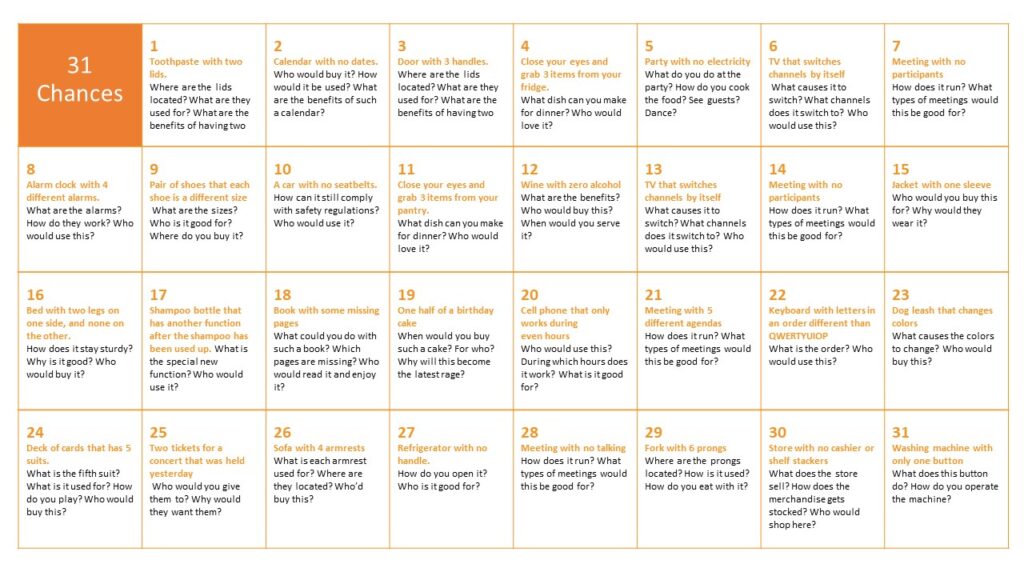
I invite you to join the FFF March Challenge (FFFMC). For each day of the month, there is a bizarre form on which to practice finding value and turn it into a real invention. By adopting FFF as an innovation mindset we can have our minds trained not to brush an opportunity off our lap when it falls in it.

[1] Finke, R.A., Ward, T.B., Smith, S.M. (1992). Creative cognition: Theory, research, and applications. Cambridge, MA: MIT Press

Green Eggs, Viagra, Constraints and Creativity

Published date: February 17, 2022 в 3:30 pm

Written by:

Category: Innovation,Methodology

There is little argument that Dr. Seuss is one of the world’s most popular and loved writers. His name is associated with imagination, creativity, talent and originality – and on a personal note – he is one of my favorite writers as well.

In 1954, after reading an article about the shortcomings of books used to teach reading to first-graders, Dr. Seuss was challenged by his friend, William Ellsworth Spaulding, to write a book that first graders “can’t put down”. But there was one additional constraint – he was to write that book using no more than 225 words out of a designated list of 348 words that every first grader should know. Dr. Seuss ended up using 236 words, of which 221 are monosyllabic (!!), to write The Cat in The Hat – a book that has been one of the most successful children’s book ever since.

As if that was not enough, Dr. Seuss’s publisher bet him that he would not be able to write another book using as little as 50 different words. As impossible as that may sound, Dr. Seuss not only won the bet – he did so with a bang. In August 1960 he published Green Eggs and Ham – the book that would become his most successful, and the 4th best-selling English-language children’s hardcover book of all time!

So what’s going on here? How did the unreasonable constraint of writing a book using only 50 different words become the catalyst for one of the world’s most successful and admired books? After all, when we try to be creative we usually go through considerable trouble to break the constraints that limit us, and certainly do not choose to embrace new constraints. Can the explanation simply be the extraordinary talent of Dr. Seuss, or is there something else at play that could be relevant to mere mortals like you and me?

Before we try to answer this question, please take a look at these Viagra TV commercials:

http://www.youtube.com/watch?v=cMhv_wCx5ug

http://www.youtube.com/watch?v=7o8_JjiLpw0

In both these commercials, and for fairly obvious reasons, the advertisers had to avoid describing in detail what their product does, or enables… This constraint is not unique to these specific commercials. What makes them unique, though, is the way the advertisers chose to deal with that constraint.

In many similar cases advertisers have tried to bypass this constraint in various ways, such as portraying men in “the morning after”, filled with energy and joy. But in the examples we just saw there was something very different. They do not contain an attempt to avoid the constraint – quite the contrary. If you think about it, what the advertisers did in both cases is to use the constraint – and in a central and conspicuous manner!

And look at the results: two commercials that are based on a unique element, and are therefore interesting, distinct and memorable; dialogues in which the use of “censorship” leads us to imagine the exact same things you just cannot show on primetime television; a central role for the product itself, as an integral part of the commercial; and last, but not least, a Cannes award for the campaign. All in all not too bad for an idea that was paradoxically inspired by the inability to do what initially seems to be so essential (yes, you can read this sentence again…)

It is interesting to compare this campaign with another Viagra campaign that also uses the same constraint in an unusual manner. Take a look:

http://www.youtube.com/watch?v=ExQKZKnk6rA

In this amusing commercial (that is even funnier the second time you see it) we witness a different way to address the constraint. Here, too, the advertisers are not running away from the campaign using something like “the morning after” approach. Rather, they are facing it head on by replacing the medium which is the object of the constraint – the language itself. The advertisers decided to go ahead and do exactly what they intended to do originally – constraint or no constraint. This “stubbornness” forced them to explore options and alternatives that would never come up were it not for the constraint.

Let’s summarize what we had so far. We saw a few examples in which we recognize a surprising connection between the presences of significant constraints and the ability to develop original and creative ideas. We can even go further to say that in these examples the creative ideas were not developed despite the relevant constraint, but rather because of it.

Yet with all due respect, the constraints did not do the creative work. That has been done by the individuals that chose to address them not as a force majeure that must be submissively accepted, but rather as raw material for a creative exploration. Not as an “end of story”, but as a starting point for a creative negotiation. And that, my friends, is exactly the insight we can take with us, and the state of mind we can learn to adopt.

Not every constraint, in any situation or creative process, can lead us to the development of an award winning campaign or a successful literary masterpiece; but some might, if we just give them (and ourselves) a chance. The widely accepted notion that constraints harm creativity, in not unreasonable; after all, constraints – by their very nature – limit the options available to us. But if we manage to change the way we view them, we may discover that in many cases they simply stop us from settling for the simple, immediate or generic solutions. And thus, by preventing us from taking the path of least resistance, they force us to explore and consider options we would never reach otherwise.

At any rate, in the complex reality we live in, the submissive approach to constraints is an omnipresent problem. When have you last faced a creative challenge, or a problem that needed a solution, in a constraint-free environment??? Constraints surround us in any task and every challenge, so that the ability to use them as a creative opportunity can come pretty handy in our professional lives (and our private ones, by the way). It does not take a lot of resources or complicated preparations – just a shift in our perspective.

So take a few moments to consider the challenges you are facing today, and ask yourselves what constraints make it difficult for you to face these challenges. Maybe these constraints can serve you in the same way the list of words did Dr. Seuss or the censorship the advertisers of Viagra. In what creative ways can you utilize these constraints? Which ideas can they help you come up with, and why are these better than the ones you came up with so far? It may take more than 20 seconds to find meaningful answers for these questions, but if you give it 20 minutes you might be pretty amazed at what you can come up with…

The original version of this article has been published, in Hebrew, on

http://shivuk.themarker.com

Listen to How you Listen to the Voice of the Customer

Published date: January 27, 2022 в 3:06 pm

Written by:

Category: Innovation Facilitation

By Nurit Shalev, CDEO (Chief Development & Empowerment Officer) and Amnon Levav, CIO (Chief Innovation Officer), in SIT – Systematic Inventive Thinking

This post brings together two very well-known concepts, the first, a key topic in the world of marketing and the second, a technique that originated in the realm of psychology and self-help:

  1. Voice of the Customer
  2. Johari window

When Nurit came to me with the initial draft of this post, the first thing that occurred to me was: great stuff, but this combination must have appeared in dozens of publications already. A couple of Google-hours later I came to the following surprising conclusion, which is our rationale for sharing with you this application of the Johari Window technique to the practice of listening to the VoC:

This is the first time (as far as we’ve seen), that the Johari Window is used not to analyze how customers perceive the company but what the company knows about its customers.

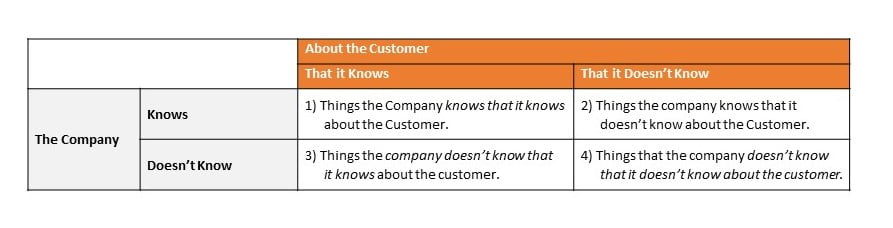
AS we all know, companies very often embark on research designed to glean insights about their current or prospective customers, whether to identify “unmet needs”, drive design of new products or offerings, or better communicate their benefits in order to eventually sell them. Our suggestion (and novelty): Before setting out to ask your customers or observe them, ask yourself and map out what you know about them, using the Johari Window framework.


What can the company learn from these quadrants, and how can this be put into practice?

1.The company already knows plenty about its customers, and the first quadrant shows what the company knows that it knows, through a variety of sources: salespeople, customer service, complaints, social media, etc. Very often, the customer also knows that you know, so: a) why waste your energy on re-verifying, and b) why annoy your customers by demonstrating that you need to be told yet again? Unfortunately, we often find our clients exploring this quadrant, mostly because it is easier to cover familiar territory. Make sure you organize this type of existing knowledge well and avoid the practice of setting out to rediscover it.

2. The second quadrant seems enticing: stuff you know that you don’t know about the customer. Tempting because you know what you’re looking for, and you know that once you find it you have expanded your knowledge of your customers. But beware: make sure you figure out why you want to know what you don’t about your customers. First, maybe you don’t know because the customer doesn’t want you to know, maybe it’s not your business to know. Second, will this information be useful, operable? Take care not to spend time nor bother your customers for collecting information that will never be utilized – you will be breaking the informal pact by which your customer agrees to share their data in return for your making good use of it for their benefit. It can, nevertheless, be fruitful to imagine what you could do with data or information that is currently unavailable. Especially when thinking of Digital Transformation, uses for data are often invented or discovered only after the data has been collected. Explore this quadrant, therefore, but handle with care.

3. The third quadrant describes a blind spot with high potential for easy wins – what you don’t know that you know. This is all the data and information that the company has, but is not aware of possessing, usually due to one or several of the following:

  • Data, or even information are strewn around in an unstructured and unorganized fashion;
  • Your own assumptions or cognitive fixedness prevent you from realizing what you know;
  • Lack of communication and silos deny access to data to those who could potentially use it within the organization.

The danger in these cases is, again, disappointment among customers who feel that they have supplied information but have not received anything in return. The potential, on the other hand, is huge. No need to spend time and resources on research, no need to take up more customer’s time, only open your eyes and mind and enjoy the fruits of information that you already possess.

4. The fourth quadrant is the most intriguing. The assumption here is that there exists information out there that will probably not be accessible using your standard procedures. Since you don’t know that you don’t know, not only are you not cognizant of the answers, but you are even ignorant of the questions. You will, therefore, need to be creative. Perhaps you can engage your customers in a process of co-creation, while observing them and listening carefully. Or you can use empathic design or other anthropologically based techniques for observing customers with a clean slate, open to discovering information that you had not set out to look for, and the customer may not have even been aware that existed. Companies would do wisely to develop these kinds of procedures and abilities, for it is in this domain that competitively valuable insights can arise. A caveat is in place, though: there is much information for which you should not rely on your customers. They not only cannot tell you what they will need in the future, they very often are not even aware of what they need or could want now. One of the worst strategies for coming up with novel ideas is asking your customers to supply them.

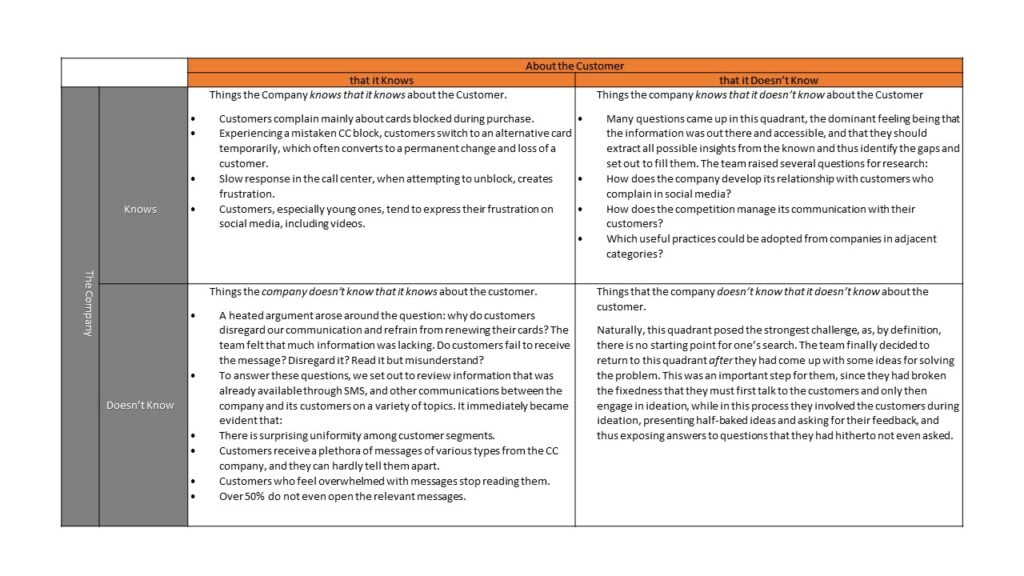
The following short case study demonstrates how the Johari analysis plays out in this context. As we prepared for a pipeline development project with one of our clients, a credit card company, the VP Marketing asked that as a first step we conduct some consumer research: “Let’s learn from our customers, listen to what they want.” All members of his management team, sitting in the room, fell silent. Their unease was palpable. They needed very little prodding to explain why: “Not another research project!”, “We have so much data already that we’re not using.” “Same questions, same answers, same ppt presentation, report to the board, no action?” Our suggestion was, therefore, to kick-off by mapping out the company’s knowledge situation as explained above. This was the result:

The information collected through this analysis led to a variety of insights, such as:

The customer obviously lived a negative experience when their card was blocked, but this was exacerbated by the presence of others, such as the attendant at the checkout, the customer’s partner, bystanders watching etc. The experience was often described using expressions such as: shame, offense, impotence, anger.

  • Some of the customers turned to the call center in real time, but most reported that response times were inadequate to the situation, failing to resolve the embarrassing situation.
  • Emotional responses to the blocking of one’s card were pretty much universal across customer segments, but reactions differed widely, including the use of social media.
  • In most cases cards were blocked due to the customer’s failure to renew their card or enable its use abroad. In both cases, the customer had received notification of the need to act but had disregarded this communication.
  • Communication overload was the main reason for disregarding these important messages that were lost in the flood of less important ones.

Based on the insights garnered through this analysis, the team went on to ideate solutions, converging to two viable and complementary concepts. At this point the team felt that they needed very little customer validation, as the ideas had been based on a deep and solid analysis of the huge amount of knowledge they had of their customers.

Time and again we find that professionals have much more information about their customers preferences and needs than they are aware of. In these cases what is required is a comprehensive and structured analysis of the existing knowledge leading to a focused search for what is missing.

Remember:

  • Don’t ask about what you already know. The customer knows that you know.
  • Don’t ask about what you don’t need to know.
  • Don’t rely on the customer for what the customer doesn’t know (e.g. ideas, future needs).
  • Trust your professionals, especially those with frontline experience, and their knowledge of their customers. Listen to the VoP (Voice of the Professional), and don’t settle for their initial response.
  • Challenge your people to challenge what they think they know, to uncover what else they know.

Knowing your customer is the basis for the success of any business, hence the crucial importance of listening to the voice of the customer, but much depends on how you listen, what you search for and mostly – your awareness of what you know and what to do with it. Our variant of the Johari Window, applied to analyzing what you know about your customer’s knowledge of you, can be a useful first step.

No innovation please, we’re too busy

Published date: January 19, 2022 в 12:00 pm

Written by:

Category: Innovation,Organizational Innovation

A few weeks ago, I spoke to a high-level manager in a financial institution. We talked about his (truly) impressive activities in the field of innovation, and then he surprised me somewhat by saying: “Next year we plan to freeze innovation activities.” Since the company is not a client of ours, I wasn’t directly affected by this decision, but still, I was curious to understand the rationale. Another victim of “the Situation”, I said to myself, but to my surprise he went on to explain: “We have so many good ideas now that we need to pause with innovation and focus on implementation.” This is, in my eyes, a symptom of one of the biggest and most common misconceptions in the field; that innovation is all about coming up with ideas of what to do (products, services, whatever it is you do). The corollary of this erroneous concept is, obviously, that once you have these ideas you don’t need to be bothered with innovation any longer, all you need is to “just” implement.

In reality, the situation is nearly the opposite. The level of innovation that needs to be invested in implementation is not lower, and very often higher, than that which is required for coming up with the ideas in the first place. But this is hardly news for anyone who is involved in the day-today of innovation within a company, such as the manager mentioned above. Why, then, is the mistake so common? It is due, I think, to the fact that people tend to see innovation as a type of activity rather than a quality of performing activities; people see innovation as an answer to the question “what are you doing?” while in fact it is the answer to “how are you doing, whatever it is that you are engaged in?” To avoid this confusion, we use a practical definition:

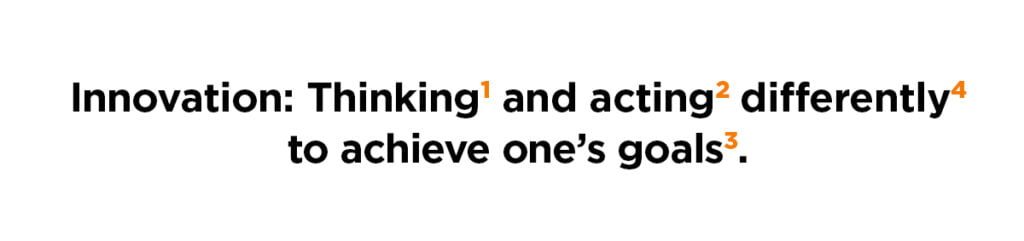
Innovation is the ability to think and act differently to achieve your goals.

This implies, obviously, that innovation is not limited to certain kinds of activities or contexts. Rather, it is relevant, as an option, in any situation in which a person or group of persons are engaged in a mental activity of any kind. In September, I was talking to a lady who is a director-level manager in a large company. “The last thing I need now is innovation,” she said, “We’ve just finished a successful innovation project, resulting in an amazing new product idea, which I’ve been trying to convince my VP for the past 3 months to OK, but with no success. What’s the use of innovating if they are going to kill your ideas anyway?” To me, it sounded like what she most needed was innovation. From our point of view, this was a classic case of an urgent need for some problem solving, the problem obviously being the need to convince a stubborn VP. And examples of this type are abundant: a VP who doesn’t need innovation because he “just” needs to get his division organized since they keep failing at implementing the great ideas in their pipeline; and of course, the innumerable CEOs who can’t talk about innovation now, because due to “the Situation” (COVID, supply chain, whatever) they see a decrease in sales, profits disappearing, and immediate danger to cash flow. My conclusion: all those people who are too [busy, overworked, full of ideas, engaged in a huge project] to innovate, are precisely those who are most in need of a change in the way they are handling whichever “too” they are immersed in, i.e. they are in dire need of innovation.

Thinking Together about Thinking Together

Published date: January 12, 2022 в 3:53 pm

Written by:

Category: Innovation,Strategy

In the old days, some 20-30 years ago, a good leader was expected to be able, usually with some support, to see the big picture, imagine most of the possibilities and consider their respective pros and cons. Today, with a world that is more connected, more dynamic and more demanding, this is almost impossible. Therefore, in recent years there is an increased use of think tanks, sounding boards and co-management practices. It is becoming just too much for anyone to handle so much information, and to consider so many variables and possible consequences on their own.

There is, therefore, a strong need to learn and acquire methods and tools that help managers think together, in effective teams.

Historically, Think Tanks were established as institutes, corporations, or groups organized for interdisciplinary research with the objective of providing advice on a diverse range of policy issues and products through the use of specialized knowledge and the activation of networks. They were policy, ideology and strategy focused and used to perceive themselves as serving the public interest. Nowadays, Think Tanks are a synonym for an ad-hoc thinking team tasked with addressing open questions or strategies, and often act as advisory boards. In recent years we see many organizations create Think Tanks to help leadership see a bigger picture and consider additional potential directions and alternatives.

With the rise in popularity of thinking teams, one would have expected a growing number of tools and platforms to support these specific needs, and yet, although we see an increase in the number and variety of collaboration platforms and software, a search for tools, methods and approaches designed to assist with managing the actual thinking, reveals that there are surprisingly few offerings. Most models focus on ‘managing the room’, i.e. facilitating discussions and making sure they are tight and efficient. Several months of experimentation with some of these models taught us that, although they do make the work process easier to manage, there was no significant increase in the quality of the outcomes.

What was missing, apparently, were elements that can improve the thinking process, and through that, the depth, quality and uniqueness of the results.

Through this experimentation, during the past three years, we collected and evaluated dozens of tools and processes. The goal was to not only identify the best tools for the job, but also enable an accelerated but gentle learning curve. We aimed to create a kit that would be easy to use, containing tools and methods that complement each other.

At the end of 2019, in a discussion with one of our clients, an innovation manager for a division in a large international corporation, we conceived the idea of creating and trying out a new model, with the excellent men and women of her division as participants and experimenters. This client had worked with us closely in the prior 6~ years, on many projects and assignments around innovation and future-facing-dilemmas and served as my (best) partner-in-crime for configuring and experimenting this new model. In the three years preceding the project, we had worked together on similar topics, so we were also fortunate to be able to assess and compare results between the use of the new model and the outcomes from previous years.


We devised the framework for the program, and with the blessing of their management team, our program was launched. Note that this is unique: that a management team, with eyes on the future and open minds, embraced the program and gave us a green light to be the first (in the world, as far as we know!) to create, learn and apply a method for people to think with others effectively.

It was important for us that the model comply with the following criteria:

  1. Self-activation – a kit that allows the team to manage itself, without need of external guidance
  2. Very short learning curve – The learning process for using the kit must be short (2-3 hours max.) even for team members who do not have prior knowledge or previous experience.
  3. Use a combination of tested tools and methodologies whose efficacy has been proven over the years and are in the public domain.
  4. Efficiency – on the one hand, a variety of tools that meet most needs, and on the other hand, stay loyal to the less-is-more principle. It was easy and tempting to keep adding tools, but the decision was to stay lean and thin and adhere to the optimal and necessary minimum.
  5. Cross-Media – the model could be used in both the physical and the virtual worlds.

After identifying the problems that a Think Tank might encounter, and determining the design principles, we began clarifying needs and characterizing possible solutions.

Our main design principles for the Think Tank kit, which we dubbed the “Operating System” should were that it should:

  • Assist in the process of setting up the teams and in recruiting participants.
  • Train participants to use tools and methods that will have a positive effect on both performance and ways of thinking.
  • Address the diversity and variety of thinking tendencies and characteristics of team members.
  • Provide tools for reflection and meta-cognition.
  • Refer to the thought-process itself and methodologically create answers to open-ended questions.
  • Address operational and logistical aspects of the work process, such as time management and knowledge sharing, as well as supply various formats for collecting and producing results and outcomes.
  • Assist in collecting insights and improving the work with the model itself.

The results were impressive: 15(!) Think Tanks invested their time and brainpower to raise important questions regarding the foreseeable future, and, using thinking processes and design tools, presented their answers and ideas. Our starting point, in this specific case, was a bank of 80+ open questions; some of the questions were presented by the management team, and many others were submitted by employees, when asked to share questions that interest them as they contemplate the next 5-15 years. Once the Think Tanks started to work, they invested very little time to learn the tools and choose their path. Next, each team selected the questions from the ‘Question Bank’ that they wanted to work on.  To do that, we used a concept called ”Fertile Questions“ – a term coined by Prof. Yoram Harpaz, in his remarkable work on Communities of Thinking. Prof. Harpaz helped us formalize a simple process so that the teams were able to create meaningful questions and develop them into concepts and applications.

From an organizational perspective, using this “operating system” yielded the following:

  • Functional teams of experts conducted focused and effective discussions
  • New ideas, that venture beyond current thinking, were created
  • Reports, testimonials, and white papers with practical implications were produced
  • A culture of focused, effective, and efficient structured discussions was established

Yet another set of outcomes was on the individual level – from formal feedback, comments, and discussions, we learned that most participants had a strong and meaningful experience. More specifically, we collected these insights:

  • The work process was easy to understand and follow;
  • The ‘All Included’ kit saved time and efforts gathering tools and knowledge;
  • A strong sense of ownership and team accountability was generated;
  • Higher levels of depth and engagement in collecting, processing and converging data and concepts;
  • Less friction and more flowing team dynamics;
  • More alignment and pride in the teams’ results.

Personally, I am honored and grateful for the opportunity to share the Think Tanks’ story and modus operandi.

I think that this entitles us to announce that we have successfully developed the world’s first Think-Tanks Operating System.


How Innovative is a Startup?

Published date: January 5, 2022 в 4:24 pm

Written by:

Category: Organizational Innovation,Strategy

Leaders of startups will typically tell you, often with energetic arrogance, that they are perfectly happy with their team’s level of innovation. In most cases, they shouldn’t be. Why, then, are managers of startups, a mostly intelligent breed, so prone to overestimating their team’s innovative abilities?

  1. Although the title “startup” can refer, literally speaking, to any endeavor in its first stages, the term is very often used to denote an initiative led by a small number of tech-savvy founders and based around a novel idea with (hopefully) large business potential. So, almost by definition, a startup is based on innovation, or at least on the potential for innovation.
  2. A startup’s founders are very often considered brilliant by their environment, and very often they are indeed bright and creative.
  3. Successful founders often manage to raise money based on their ideas, which confirms their perception of their ability to invent stuff that others like.
  4. As startups raise funding, they tend to pay generously to founders and employees, which further feeds their sense of self-worth and their self-perception as great innovators.
  5. In the first stages of its lifecycle, a startup often focuses much of its effort and energy on R&D, creating the (misleading) equation: “we focus on R&D – therefore we are innovative”.


None of this is totally baseless: startups do indeed tend to be innovative to a certain extent and in certain domains, and their founders and early employees probably tend to be more creative than average. Still, in our combined 50+ years of experience, we have found that founders and members of startups suffer from fixedness just like members of any other type of organization. In fact, because of the phenomena mentioned above, they are often in danger of being even more blind to their innovation-deficiencies than most. Whether this is the reason for the dramatically high rate of failure among startups is debatable, but it is interesting to note that this dismal record is, for some strange reason, accepted as the norm. A closer look at the role of innovation in startups’ development could perhaps provide a clue to some possibilities of changing this currently accepted suboptimal performance.

The following questions can help throw light on several common blind spots, related to a startup’s innovation status. You are welcome to ask yourself these questions about the startup you have founded, work for or have invested in as a mini-diagnostic exercise.

  1. Granted, your founder is a mathematical genius, her algorithm is unique and powerful. While the team works on developing applications to the algorithm, is she thinking about the next step? Is she in love with her original invention or is she willing to pivot? Is she able to come up with the novel ideas needed for pivoting?
  2. Is all your startup’s innovation concentrated in the brain(s) of the founder(s)? Or are there additional innovative ideas being generated by others in the team?
  3. Do you have mechanisms for sharing thoughts among team members, so that ideas can be developed jointly in open and productive conversations? Or are thoughts exchanged only in improvised brainstorming sessions with members sitting around and throwing out ideas?
  4. Does anyone make sure that valuable thoughts, comments and ideas get documented?
  5. When you think of your startup as innovative, which aspects of its activity are you referring to? Only R&D? Have you fallen into the trap of thinking that innovation relates only to R&D?
  6. Have you had any innovative ideas lately about go-to-market strategy or tactics? Are you planning to offer your product only to the usual-suspect-segments? Or have you challenged yourself to think about totally different alternatives to your market promise and targets?
  7. Do you have a problem with hiring talent (probably, since most everybody has)? Have you treated this as a topic for innovation, or are you simply joining the herd by offering high salaries and other goodies to tempt promising prospects?
  8. Do you find the time to discuss less-probable future scenarios? To challenge your assumptions?
  9. As you grow, what is your strategy for maintaining the innovation level that created your startup in the first place? If you’re betting exclusively on the founders’ creativity plus recruiting creative talent, do you think it is enough?
  10. Is money constraining your ability to innovate?
  • Initially, when scarce, do you hold on desperately to what you have, afraid of “distractions” such as opening your strategy to candid assumption-breaking discussion?
  • Later, when abundant (hopefully), throwing money at your problems instead of finding innovative solutions, the hard way?

If the answers to none of these questions seem to warrant a change in your modus operandi, you are either misleading yourself or in excellent shape😊. If you do find that you may benefit from a more structured approach to your innovation strategy, here are three strong recommendations:

1) Make time to deliberately discuss how to be more, and more correctly innovative. Not by the way, not as part of your normal R&D activities, but dedicated, raising-your-head and breathing time.

2) Make sure to hold at least some of the discussion with the help of an external facilitator. They do not need to be experts in innovation, but they should know how to facilitate a tough discussion with hard-headed participants (yes, you and your team).

Once you’ve followed the first two recommendations, chances are that you are on the right track. To make sure you are, and to accelerate the change, you can follow recommendation number 3:

3)     Enlist the support of innovation experts, who follow a methodology and have accumulated plenty of experience with other companies (yes, true, we are such experts, but there are others out there as well).

You will be surprised at how much of a startup’s culture and practices down the road will be determined by taking these steps at the outset and how these steps can help prepare the team for the hurdles on the way to success.

How to Optimize both your Innovation Portfolio and your New Year’s Resolutions

Published date: December 29, 2021 в 12:30 pm

Written by:

Category: Innovation,Strategy

Trigger warning: this post is a bit silly. It is silly for two reasons, that I will explain in the sentence after the next. But before that, I want to claim that although silly, it may be worth your while reading the post for one single reason: the simple tool that I describe here is very useful. But, granted, it is silly, because:

  1. It uses as an example the tired cliché of New Year’s resolutions;
  2. Like so many other pieces of good advice, it is simply a piece of your grandmother’s common sense, neatly packaged for contemporary use.

An interesting aspect of the tool I present here, which we call NFS, aka Near-Far-Sweet, is that it was derived by us from a concept presented in the context of education by the Russian sociologist Lev Vygotsky (1896-1934). The concept is called Zone of Proximal Development (ZPD) and it relates (apologies for the simplification) to the level of potential mental development of an individual (in the original context, a child).

Borrowing somewhat loosely from ZPD, observe the process of landing on the right New Year’s resolution when you wish, say, to get in better shape and hopefully shed some weight while you’re at it. These are two versions of an idea that you may come up with:

  1. Take the stairs up to your 3rd floor office every day;
  2. Go out for a 3-mile jog three times a week, and a 5-mile jog every weekend.

Common sense immediately indicates that option 1 is too weak, since climbing two flights of steps once a day or even twice doesn’t really keep you in shape (and even less so if you must first get into shape), while option 2 is very powerful and can probably lead to a dramatic change in your physical conditions. But, alas, the probability that you will stick to option 2 beyond the first two weeks of January are pretty slim, if you can even get yourself to launch the plan.

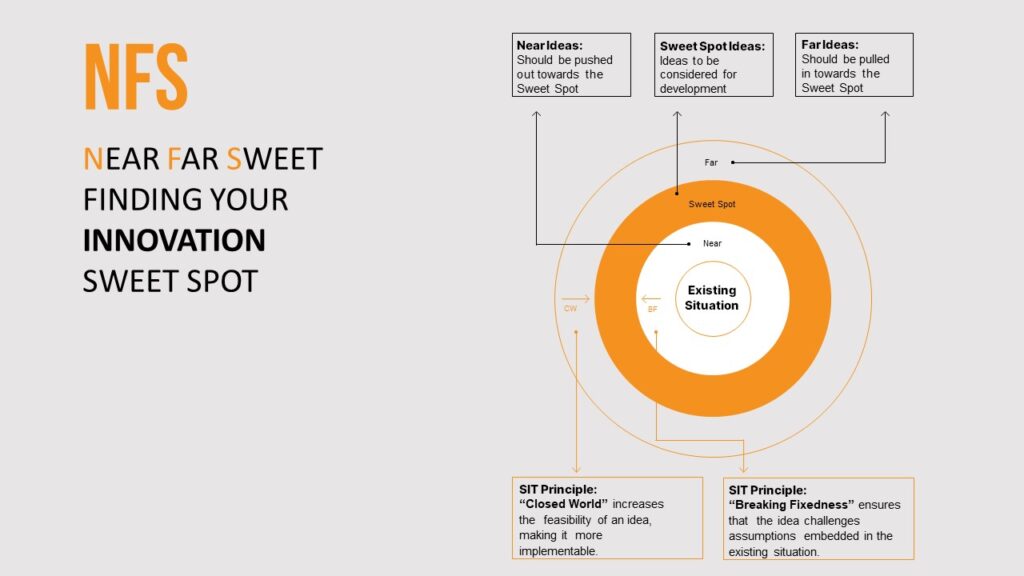
Ideas of the first type we call Near, the second, not surprisingly, Far, and those we are seeking, are labeled Sweet: What you need is a New Year’s resolution that is far enough from current practices to make a difference, but near enough that it can be viable to implement.

This is the Near-Far-Sweet (NFS) model we use to map out ideas. We often use this model when working with companies on creating their idea pipeline, following an ideation exercise. But, what should one do once ideas are mapped as N or F or S? How can this help in actually creating and implementing valuable ideas?

As part of his Zone of Proximal Development model, Vygotsky also introduced the concept of scaffolding. When we aim to lead a child to live up to their potential, how high should we set the bar? Too low, and we are not challenging them to go beyond the obvious. Too high, and they will probably end up frustrated and lose confidence. The Sweet Spot (mixing terminologies here) is a place in which – with the help of scaffolding – the child can reach the maximum level that their potential allows. In Vygotsky’s educational context, scaffolding very often takes the form of an older person, with the capabilities and motivations to accompany the child on her or his challenging journey to the higher reaches of their potential for development. In the context of product development, we propose that facilitation, with the proper structures, can do the scaffolding job.

Back to your New Year’s keep-in-shape resolution: perhaps not every single day but two or three times per week, and maybe 2 miles rather than 3 may be your Sweet Spot? Better figure it out before you make a commitment,  and even this Sweet resolution will be more attainable if you enlist a personal trainer, or convince a friend and neighbor to join you and thus become each other’s scaffolding.

The next step after mapping your ideas, whether for leisure or work, is to turn your attention to the Ns and the Fs. When working on a pipeline of existing products or services:

  1. Near ideas are often created as variants on existing offerings. They thus tend to be easy to imagine, implement and also communicate to potential customers. But, given their similarity to known offerings, they seldom justify for the customer the cost of switching from their current practices. The objective, therefore, is to push the idea outwards, further away from the current version, and into the Sweet Spot. This can be done by applying tools that break mental fixedness about the current product.
  2. Far ideas are typically exciting for their intended customers, but lacking in a clear path to implementation. Or sometimes, even though they can deliver a strong benefit for the customer, it is hard to communicate clearly what this promise is. In these cases, we utilize the Closed World principle, focusing on resources that are already at our disposal that can help concretize the idea, make it easier to implement or assist in communicating its value.

Much of this is pretty obvious – remember, I warned you – but surprisingly overlooked more often than not, resulting in the following common mistakes:

  • Coming out to market with unexciting ideas, and then lamenting that “80% of product launches fail”. Of course they fail, if what you offer is so more-of-the-same.
  • Giving up on ideas because they’re perceived as not exciting enough in focus groups or other VoC gathering techniques, before giving them a chance by pushing them further out towards Sweet.
  • Giving up on exciting ideas because they either seem to be impossible to realize, or fall by the wayside in the attempt, rather than insisting on making them viable.
  • Trying to launch Far ideas, technically feasible but still out of scope for the imagination of existing potential customers, rather than pulling them inwards to the Sweet Spot.
  • Settling for Near ideas out of fear or laziness, and then brainstorming wildly to produce Far ideas, to prove that you’re “innovating”. And a corollary:
  • Claiming that “we don’t have a problem with ideas, we’ve got plenty of good ideas”, without noticing that this “plenty” is made of Near and Far ideas, with none in the Sweet Spot.

So, if you insist on making New Year’s resolutions, against all odds😊, maybe try some version of applying the NFS principle on yourself, your kids, your pipeline?

Happy New Year!

Get our innovation model that has worked for 1000+ companies.

    No thanks, not now.

    sitsite
    Privacy Overview

    This website uses cookies so that we can provide you with the best user experience possible. Cookie information is stored in your browser and performs functions such as recognising you when you return to our website and helping our team to understand which sections of the website you find most interesting and useful.