
How to Embrace Failure Without Falling on Your Face

Published date: August 4, 2021 в 3:30 pm

Written by:

Category: Innovation,Methodology,Strategy

Tags:

Many years ago, I presented what I considered to be a very cool project to an extremely smart VP of Marketing in a large B2C company on the East Coast of the US. Fortunately, she shared my enthusiasm, and the process of engaging us for the project was running along nicely. It was an ambitious and somewhat risky project in the sense that it required the involvement of about 20 high-level managers who were very skeptical about its chances of success. This put “my” VP in the stressful position of either ending up as the initiator of notable success or being forever remembered as the perpetrator of a huge mistake (could she embrace failure?).

At some point, she asked me: “Can we make absolutely sure this will succeed?”And, silly me, I answered with a big smile: “Of course not. Don’t you remember? One of our key messages in this project is that if you innovate you must embrace the risk of failure. So since we are designing such an innovative project, of course, there is a risk that it will fail.” Obviously, we didn’t get the project, because, regardless of the oft-quoted cliché, nobody really wants to “celebrate failures”. People want successes. And if there is one thing they will avoid at all costs, it is failure.


Embracing Failure, the Contradiction


There seems to be a contradiction: We want to think ahead. We want to try new things. We want to innovate and embrace failure as part of the inventive process. At the same time, we want to be in control of our outcomes. We cannot afford to make mistakes.

This leads to a dilemma: Companies encourage their employees to fail and learn. But they expect them not to fail.

Failures are at best unwanted – at worst systematically concealed, to avoid blame or punishment. Pressure is a means of control. The result: a fear of failure.

The prevalence of fear of failure in companies is alarming considering how paralyzing it can be for the companies’ development.

Three reasons for this troublesome effect:

1. Risk Aversion

Here is one cliché that is absolutely true: Failure is an essential part of innovation. When prototyping a new product, expect failure. That’s what prototypes are for, and that is why you will work on several consecutively, or even in parallel. Therefore, the maxim fails fast and try again.

But, if every failure is considered a mini-disaster, who wants to even consider risking it? Rather, the ultimate goal is to achieve full control of the process. Hence, any change or novel idea is treated as a potential threat.


2. Loser-phobia

If one strives to overcome one’s Cognitive Fixedness, a fundamental tool is the ability to reflect on one’s actions and to engage in metacognition (a reflection on one’s thinking processes). Every failure thus becomes a source of learning and a driver of change.

But, when your failures are perceived as a sign of being a “loser,” what are the chances that you will actually take the time to confront your failures, reflect on them, and draw useful conclusions?


3. Who? Me?

In cultures that do not truly accept failures, there is a strong incentive to underreport them and to avoid any public reference to them, let alone an open analysis.  This greatly increases, obviously, the probability that the same mistakes will be repeated. A good litmus test: Ask anyone who tells you that you should “embrace failure”, if they are willing to share a recent one of their own. Most chances are they won’t, and that tells you what you will be risking if you share yours.

You probably agree that it can be very beneficial to embrace failure in certain areas – in an honest and consistent manner. But in other areas, we cannot allow for mistakes. The point is, to make this distinction explicit and communicate it to everyone involved. Clarity is key.


Instead of pretending to universally embrace failure, you map out areas in which failing is acceptable. Then, you commit yourself to this map.

Here are some actions you may consider to embrace failure:

Mark your “control towers”

Imagine working in a control tower. There is obviously no way to embrace failures here. Imagine an airport with 5000 landings and take-offs per month. a mistake rate of 0.01% would imply 5 crashes per month. There are such “control towers” in every company. In some areas, even if a leader doesn’t care to admit it, failure is not an option. Being explicit about your “control towers” is crucial, if you want people to avoid these specific mistakes at all costs. Only then, everyone is on the same page: We give our best to prevent failure and if it happens, we report it. In other areas, the expectation might not be as clear. 

We suggest three mechanisms: define roles, draw lines and install safety nets.

When defining roles, you assign to a specific group of employees the role of innovators. It is then clear to everyone that this group will generate ideas, try new things – and occasionally fail. Your “innovators” will enjoy the freedom to explore and develop new ideas. At the same time, they will be accountable for their failures as part of the process.

Drawing lines means, defining which parts of a project are open to experimentation and those that are not. Within the defined lines, failure is acceptable. Innovation is welcome.

Safety nets are a similar idea, on a different level. To limit the impact of failures, you innovate in specific areas, e.g. those that are not part of your core business.

In defining roles, drawing lines and installing safety nets, we map out areas in which failures are acceptable. Only then we can truly claim: We embrace failure. Feel free to innovate.

In addition to the above actions, you can also utilize some advice from experts on the subject. 

Have a backup plan

Leon Ho says that it never hurts to have a back-up plan. The last thing you want to do is scramble for a solution when the worst has happened. “Hope for the best, prepare for the worst.” This old adage holds solid wisdom. Having a backup plan gives you more confidence to move forward and take calculated risks.

Perhaps you’ve applied for a grant to fund an initiative at work. In the worst-case scenario, if you don’t get the grant, are there other ways you could secure the funds? There are usually multiple ways to tackle a problem, so having a back-up plan is a great way to reduce anxiety about possible failure.

Leon Ho (https://www.lifehack.org/articles/lifehack/how-fear-of-failure-destroys-success.html)

Identify the consequences

Theo Tsaousides says that in order to attenuate fear of failure, first identify the consequences of failing that scare you the most and evaluate your ability to deal with these consequences. Instead of talking yourself out of the fear by hoping that nothing negative will happen, focus on building confidence to deal with the consequences.

Here are some questions to ask yourself:

  1. Which of these consequences scare you the most?
  2. How much impact will they have on you? Are they merely unpleasant or life-threatening? Will they just make you feel uncomfortable, or will they hurt you deeply and irreparably?
  3. How quickly will you move on? Are the consequences permanent or reversible? Are they short-lived, or will they linger forever?
  4. How well can you handle them? Can you exercise damage control, or will you hide and disappear?

Theo Tsaousides (https://www.psychologytoday.com/us/blog/smashing-the-brainblocks/201801/how-conquer-fear-failure)

Now that you’re equipped with the knowledge, it’s your turn: Tell us about YOUR experience in dealing with a Fear of Failure and check out one of our latest article on how to manage airtime!

On Indicators and Measuring Innovation – Part 1

Published date: August 1, 2021 в 2:00 pm

Written by:

Category: Innovation,Organizational Innovation

On June 30th, I posted about the meaning of the term “innovation”. These were the post’s opening sentences:

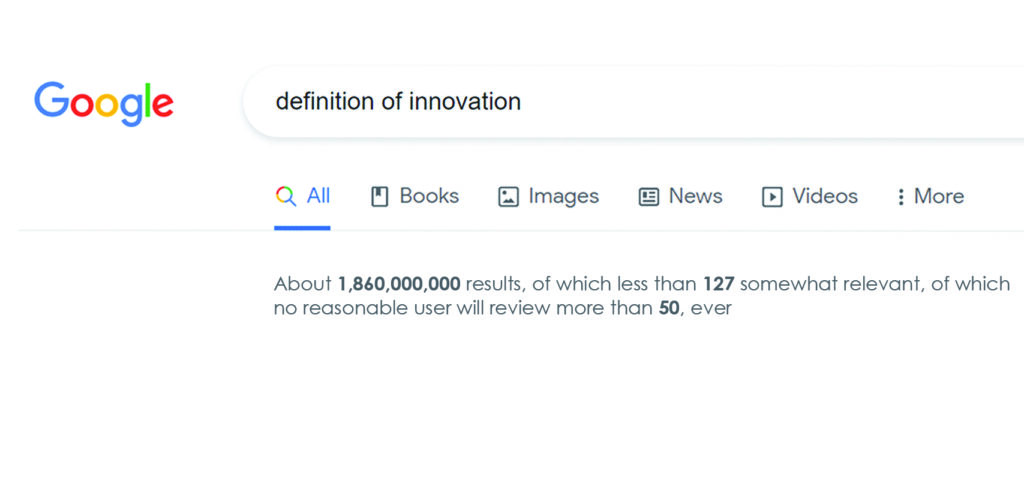
When I typed “definition of innovation” into Google the other day, I came up with 1,710,000,000 replies, which means absolutely nothing, of course, raising the question why the arguably most influential company on earth has been consistently feeding us with this useless piece of data for so many years. So, I promise to use this very same opening sentence in a future post (repurposing, saving on first-sentence-emissions) about some common popular fallacies around indicators and measurement.

Keeping my promise here, I reiterate my bewilderment and will attempt to use this example to shed some light on the oft-asked question: how should innovation be measured? This question came up yet again last week in a conversation with an Innovation Manager in a medium-sized financial company. “They [management] are demanding that we boost innovation throughout the company when I don’t even know what innovation is nor have any idea how to measure it.” The former question was addressed by the post mentioned above. In this post (both parts) we will address the latter.

Here, in Part 1, we will start by using the example of Google’s indicators to share some observations on what should or shouldn’t be done when measuring performance in general. In Part 2, we will analyze some specifics of measuring in the context of innovation.

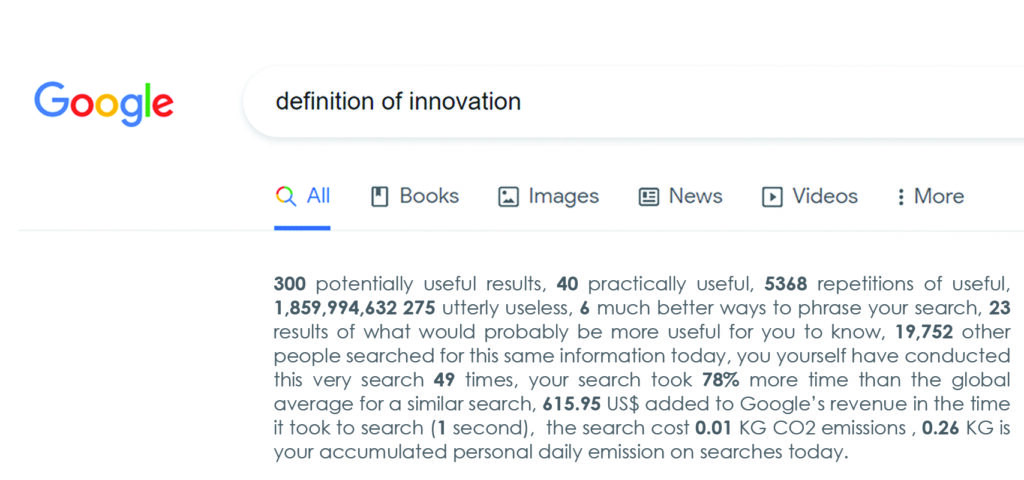
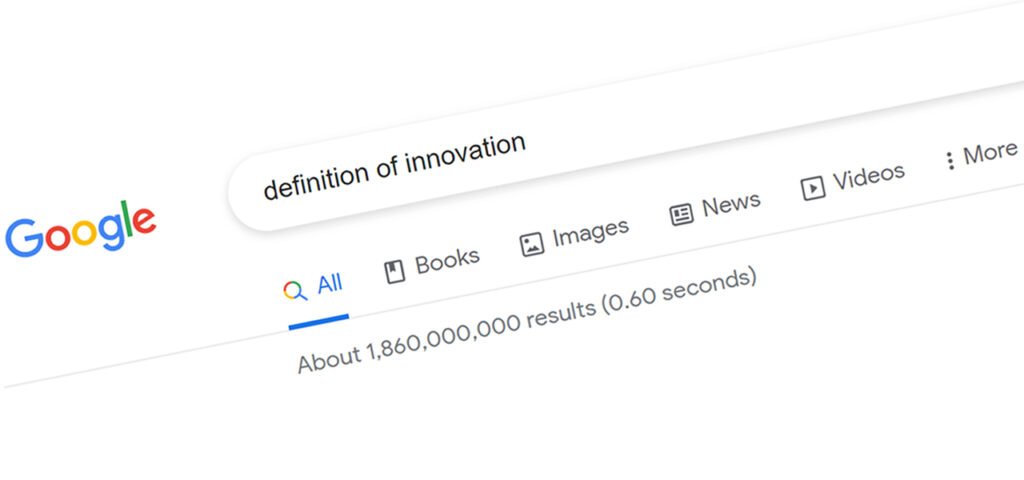
As I write this, I repeat my search for “definition of innovation”. Why does Google choose to share with me that my search took 0.60 to complete and that it came up with 1,860,000,000 results? Why would I care? What can I do with these two pieces of information? One can imagine that in the late 1990’s this pair of indicators served to signal both “look how fast our engine is”, and “see how many results we can provide you with”. Even then, there was a glaring discrepancy between the search engine’s stated differentiator and the indicators communicated. Google claimed the superiority of its algorithm based on the quality of its results, not their quantity nor the speed of their delivery, so why were they boasting characteristic #1 while measuring #2 and #3?  This is the result of my repeated search today:


Keen readers will have noticed that the number that appears above constitutes an increase of 150,000 finds over my former search, quoted in the opening paragraph. Say that Google has indeed found 150,000 additional hits in less than a month. So what? Have I gained anything from this increase? Obviously not. Clearly, then, these indicators have not been selected to cater to my needs as seeker of information. Why were they selected then? One suspects that a possible reason is that they are simply easy to measure. So, the first observation on the misleading use of indicators is:

Observation #1: People and organizations tend to skew towards indicators that are easy to measure.

Ben Gomes, Google’s Vice-President of Engineering, has been quoted as saying, “…our goal is to get you the exact answer you’re searching for faster.” He goes on to explain: “Our research shows that if search results are slowed by even a fraction of a second, people search less (seriously: A 400ms delay leads to a 0.44 percent drop in search volume, data fans).”

Note that although the professed goal is to provide an “exact answer” there is no indicator to measure to what extent this important measure has been attained. This lacuna may be attributed either to a harsher variant of Observation #1 (above):

Observation #1*: If you haven’t figured out how to measure something, disregard it (even if you know it is crucially important).

Or, in more unfortunate cases:

Observation #2: If you’ve figured out how to measure it, but you’re not happy with the results, hide them.

For obvious reasons, we don’t expect Google to show us a search result that looks like this:


But wait, you may say, the Google VP did explain the huge importance of speed, so that is a crucial factor that should be measured. Yes, it may be crucial, but for them, rather than for you. This, then, is a prime example of:

Observation #3: Technologists and bureaucrats will tend to measure and communicate indicators that are important for them, rather than for their users/clients.

It is, no doubt, of the utmost importance for Google’s techies to measure and monitor the precise duration of each and every one of the 5.4 billion(!) daily searches (2020) on their awe-inspiring platform. But that does not at all mean that this specific piece of data about my search is of any interest to me. Ask yourself: Have you ever noticed this number? If I tell you that your search x took 0.36 seconds or your search y an agonizing 0.72, would these numbers mean anything to you? It is a stretch to imagine that Google, with its 135,301 employees and 182,527 billion US$ revenue (both numbers refer to Alphabet, end of 2020) can’t figure out that these two indicators are respectively useless and meaningless to their users. Why then, do they appear so prominently? Another possible explanation could be:

Observation #4: If you prefer to avoid sharing certain indicators, direct the spotlight to others.

This may be the most sensible explanation of the Google indicator puzzle: speed and quantity may actually be playing the role of what I propose to name “decoy indicators”. The function of this class of indicators is to enable a company to offer a semblance of transparency, while in fact obfuscating all those indicators that its audience could really be interested to monitor but is not even aware of. The Google-search-indicator-set of our dreams would maybe include some or all of these:


A majority of these indicators would probably be as useless to most of us as the two original ones, but would at least supply a welcome variation on the theme, or perhaps could be rotated throughout searches so that the user would either select those she wished to see or would be served a random selection of 2-3 each time. The other indicators could, say, be accessed by clicking on an icon. Does it really matter which indicators are selected? It could, very much.

Nine years ago, when we took our 3-week old youngest daughter to our favorite pediatrician for a small check-up, he noticed a minor irregularity and prepared to perform a small but invasive test on her. I stopped him and asked why he was planning to do so. He answered that it was “the protocol” and would supply him with a piece of important data which he would register in her newly created computer file. When I asked whether the value of this data would determine any specific action to be taken, he admitted that it would not. I therefore asked him not to perform the test to which he immediately agreed. This incident re-confirmed a rule I strictly follow in all my dealings with medical staff to the chagrin of many of them: always politely request that they provide a simple rationale for whatever action they are about to perform. Surprisingly, very often they are not able to do so, apart from quoting “the protocol”. The corollary of this rule for medical tests or examinations, as for measurements in general is:

Observation #5 When you select or design an indicator, make sure you know precisely what you want to know and why.

Even if the price of measuring and communicating a useless indicator is low (even lower than the minimal invasion of my daughter), you would do best to avoid it, as indicators tend to take on a life of their own by bestowing undue importance on the measured quantity.

Observation #6: Indicators, even if selected for the wrong reasons, and therefore useless, will appear important because they’re there.

And, once the indicators are there, you will find yourself playing the corporate-Edmund-Hilary and inevitably climbing the management-imposed-Himalaya, diverting energies from other, more constructive endeavors. This is one of the reasons that we all at times experience a certain unease even as we are exceling according to some set of indicators or other. Deeply, intuitively, beneath our superficial satisfaction at hitting our numbers, some voice is asking: but what for?

In the next post (Part 2) we will discuss how these phenomena play out in organizations’ attempts to measure their level of innovation, as they use indicators such as number of ideas submitted to idea-boxes, number of patents, % of revenues spent on R&D, % of sales derived from new products and other commonly used indicators. We will see that many such standard indicators can be applied usefully, depending on timing and context, and will review several examples, exploring how they can be constructively put to good use.


Fly High – The Fosbury Flop

Published date: July 28, 2021 в 2:22 pm

Written by:

Category: Innovation

Whenever the Summer Olympics come along, I think about the many times I have heard my good friend and colleague, Dr. Jacob Goldenberg, so eloquently tell the story of (one of) the greatest sports innovations in history: the Fosbury Flop.

Common wisdom dictates that evolution does not result in revolutions – this is the difference between incremental innovation and breakthrough innovation. At SIT, we’ve been challenging this fallacy for decades. That’s why I love the true story behind the Fosbury Flop, which proves, once again, that common wisdom is a highly unreliable source for practical conclusions.

The Fosbury Flop? Never heard of it…

In 1968, a young high jumper by the name of Dick Fosbury revolutionized his field by winning the Olympic gold medal with a back-first flop that he himself had invented.

Why do we claim that this was revolutionary? There are several indications…

1)    The Official Web Site of the Olympic Movement states: “An athlete will never again invent such a revolutionary style. Since this high jump approach, all specialists have adopted the “Fosbury flop” and the world record of the time, held by Soviet Valery Brumel (2.29 m) was quickly broken.”

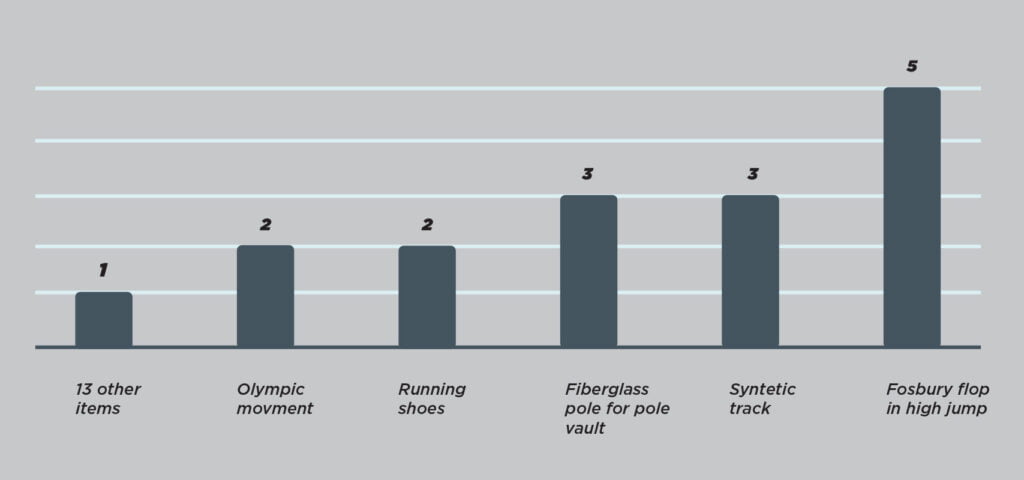
2)    Jacob and his colleagues asked 6 sports experts (sports historians, broadcasters, commentators) to each name the 5 most influential innovations in the history of sports. 5 of the 6 mentioned the Fosbury flop.

3)    They also asked two dozen judges to rate the innovativeness of 9 sports innovations (including: the game of soccer, swimming techniques, the synthetic track, running shoes, and participation of women) along a list of parameters. The Fosbury flop rated highest overall and first place on its impact on sports, its originality, and its revolutionary nature.


Now that we’ve established that, what’s the story?

At the age of 10, Fosbury learned a high jump technique called the Scissors, which he had copied from some children in his school. At the age of 11, in the fifth grade, Fosbury’s Phys Ed teacher and coach taught all the kids trying out for track to use the Straddle or “western roll” style. After switching to the straddle and beginning all over, Fosbury fell behind the other jumpers competitively. He was very frustrated and asked his coach if he could revert to the old scissors style to get a better result and maybe boost his confidence a bit. His coach conceded.

So Dick decided to try his old style during his next competition. Feeling awkward yet persistent, Fosbury managed to clear his previous best jump of 1.63 meters, and then, facing a new height, knew he had to adjust something. With the scissors style, the jumper typically knocks the bar off with his/her behind, and sometimes with the movement of the legs. To avoid this, Fosbury tried to lift his hips up higher, which dropped his shoulders simultaneously. Fosbury cleared the height. He continued raising his hips until he eventually cleared 15cm higher for a new personal record, and even placed fourth to score points for his team. No one knew what Fosbury was doing as he transformed this old technique into something new, as each attempt was a little different. The opposing coaches checked the rulebook for legality since Fosbury had unexpectedly begun to beat their jumpers.

The next two years, 1964-1965, involved a slow evolution in the technique. Using his curved approach to the bar, Fosbury intuitively began to turn his inside shoulder away from the bar, to get his head over the bar sooner. Thus, the following year, pictures show Fosbury clearing the bar with his body at a 45-degree angle to the bar, no longer parallel to it. By the second year, Fosbury had fully evolved to clearing the bar with his back to it, arching his hips over, then un-arching to kick his heels over and land on his back in the foam pit. In other words, two years of small incremental changes were required for Fosbury to come up with the final, apparently radical, version of his jump.

Dick Fosbury had never envisioned being an Olympic athlete, even up until the 1968 Games. He maintains that he did not set out to change anything — in his own words, “I just wanted to play the game”.

And he did. As the story shows, his is an example that Radical innovations can be the result of a sequence of incremental steps (and oftentimes are – we just don’t notice them due to the perspective of time).

Thanks, Jacob, for sharing this story with me!

How One Man Changed the High Jump Forever | The Olympics on the Record

Errors of Exclusion: Two Blind Spots when Planning your Innovation Initiative

Published date: July 25, 2021 в 5:27 pm

Written by:

Category: Innovation,Organizational Innovation

We’ve written plenty and posted some in the past about common myths and misapprehensions around innovation. “Not again!”, you say to yourself. For what’s more annoying than some self-important consultant(s) telling everyone how wrong they are. True. On the other hand, as we work in multiple organizations, we just see, and commit(!), so many mistakes that it seems a pity not to share what we’ve experienced, in the hopes of saving this learning-the-hard-way from as many of you as possible. But will reading through lists of mistakes really save one from repeating them? To a certain extent this is so, as alluded to in the famous saying by George Santanaya: “Those who cannot remember the past are condemned to repeat it”. But note that, logically speaking, even if Santanaya was right, this doesn’t necessarily imply that those who do remember the past are immune from repeating it. As anyone who has raised a child will readily attest, some mistakes need to be committed and experienced in the flesh so that one can learn from them. Still, it is my belief that even if you are destined to step with eyes wide open into some traps anyway, being forewarned will help you pay a lower price, learn from the event, and maybe even adjust your course in real time. That is is why we will continue to share with you, from time to time, small collections of mistakes that we witness during our work with organizations.

“Those who cannot remember the past are condemned to repeat it”.


This time we will focus on two misconceptions that have to do with the way those in charge of launching an innovation initiative assess their colleagues – their target audience, when designing an innovation program and its execution. Both can be seen as blind spots leading to an exclusive, rather than inclusive approach, often with dire consequences, but both can be overcome with awareness and care, perhaps aided by these practical conclusions and recommendations:


1. Black/White Vision:


Champions of innovation (and their consultants) often tend to perceive their colleagues through a divisive lens: the cool, positive, usually younger allies-in-innovation, versus the stubborn, probably older, laggards who are getting in the way of innovation with their “resistance”. As is the case with other stereotypes, this one, too, has some obvious basis in reality. But more often than not, those who “resist innovation” are, in their exasperating way, performing one of several useful roles:

  • They may be pointing out to important aspects that should be maintained and safeguarded when the change-tsunami sweeps through the organization;
  • They may be faithfully representing a voice of the customer, who might also find it challenging to adapt to some changes;
  •  They can inadvertently play the role of the proverbial canary in the mine, thus pointing out flaws in your innovation initiative or sensitive areas where you should pay more attention;
  • In many cases they are simply right in their resistance to a specific change, either because in this specific case it makes more sense to maintain the status quo or because it would be wiser to keep searching for a better alternative.

Given these not-so-improbable possibilities, here are a few recommendations:

a.    Listen. Listen, listen. Not fake listening, just to give the laggards the feeling that they are being heard, but sincerely consider the possibility that they may be saving you from yourself. Even if their true motivation is fear of change, they may still be right.

b.    Don’t assume that veterans and older associates will necessarily be harder to convert or less able to contribute to an innovation initiative. On the contrary, they will often be its anchors, supplying the knowledge and experience to make it work. (Disclosure: the youngster writing this post has chugged by his 60th anniversary a few months ago.)

c.    Don’t waste energies convincing recalcitrant managers or units. Learn from them what you can, invite them to join, and if they are still resistant, give them the time and space to join in at their own pace. Time may not yet be ripe for them, or they may be adopting a cautious strategy of first making sure that what you are offering actually works. In the worst case, they will jump on the bandwagon when it reaches cruising altitude (sorry, mixing a few metaphors here).


2. Disregarding the Middle:


To the perennial debate whether an innovation initiative is best conducted top-down or bottom-up I offer two responses, both frustrating:

  • Both are necessary, to such an extent that you will probably fail unless your plan integrates both approaches. I’ve personally seen each of the two approaches being carried out disregarding the other, always with dismal results. The more common mistake in my experience is the exclusively top-down execution, whereby most of the energy and attention of a corporate unit and its external providers is dedicated to pleasing top management and enlisting their support as expressed in bombastic declarations and budget approvals. I, personally, have tended to err more in the opposite direction, advocating for a predominantly bottom-up course of action, and found to my disappointment, that even though you can achieve wonderful results by empowering the rank and file, if you fail to align with and receive substantial support from top management the entire initiative will sooner or later run out of steam, probably sooner. A combined bi-directional effort is a necessary condition for success. I recommend this as a non-negotiable condition, even if it results in a more complex, and costly, program.
  • The combination of TD and BU, although a necessary condition, is not sufficient. In a typical corporation, or large organization of any kind, it is a third layer, middle management, the company’s backbone, that determines the success of an innovation initiative. Imagine a Marketing/Business/Product Director, say, in an FMCG multinational. Her team is all fired up about an upcoming innovation training, the President of the company is being interviewed in Forbes as an inspiring example of a leader who understands that “now, more than ever, the only constant is change”. So, she is sandwiched between both a BU and a TD innovation-promoting buzz. But while all this exciting discourse is buzzing around her from below and above, who will guarantee that her business unit hits the numbers this quarter? And where will the extra head count come from, if she is made to send her people to yet another course and waste others’ time on innovation forums and conferences? And, as the President halks those futuristic, exciting G3 products that will (hopefully) hit the market in 2024, after sucking up the entire R&D budget, who will fund the tweaks and adaptations that clients are clamoring for in their G2 product orders, without which there is no chance to sell the 500 million USD of the much maligned (in comparison with glorious G3) G2 wares? Middle managers, for the most part, are smart and savvy: they will figure out myriad ways to maintain the balancing act of subtly subduing their reports’ innovation-energies while posing to their superiors as innovation champions, all this whilst squeezing out the business results that everyone’s bonuses depend on. Middle managers are therefore the killers of most innovation initiatives, unless, that is, they are tasked with leading them.
 

To sum up this post’s message about an innovation leader’s two blind spots: no, all those old timers and other innovation-resisters are not your enemy, they should be listened to attentively and brought on board gradually according to their respective timelines and needs, and yes, you do need a Bottom-Up approach and you must combine it with serious Top-Down support, but the mix will only work if your innovation initiative is built around and under the responsibility of your organization’s backbone, its middle management.

3 SIT Case Studies to Inspire Your Company’s New Product Development

Published date: July 21, 2021 в 4:19 pm

Written by:

Category: Innovation,New Product Development,Strategy

Companies are constantly trying to create something fresh and original, but where do they even start? A common go-to is good ole brainstorming, but as we have repeatedly stressed, this is not an effective way to ideate. That’s when SIT steps in – making ideation more efficient and creative through proven, structured strategies and methods. SIT’s project outcomes are commonly true revolutions in the sector, even though they are based on your existing products or services. Here are some NPD case studies that we are proud to have led, which exemplify SIT’s methodology in practice.

Not Just a Summer Drink

On a scorching summer day, nothing is more refreshing than a nice, cold bottle of iced tea. But what about the wintertime? How can a Business Unit that sells such summer staples like Nestea® also boost sales during the colder months and gain an edge on competing companies such as Lipton, the leader in the industry? 

Nestea’s traditional approach of identifying market trends to develop new products was not generating enough revenue. Moreover, non-compete restrictions from a joint venture of their parent company, Coca-Cola/Nestle, put further pressure on Nestea® to steer clear of soft drinks and hot beverages. Thus, the Nestea® brand team needed to develop a new product that was unique in their own domain. They called in SIT to help innovate under these constraints.

During the process, we applied our attribute dependency tool, which creates and dissolves dependencies between variables of a product, SIT was able to help Nestea reevaluate the relationship between changing seasons and beverages offered. Nestea’s® team challenged the expectation that iced tea is only for the summer and launched a line of iced tea for the winter. Applying their existing strength in flavor innovation to ensure the development of a unique and unexpected product, they landed on a concept that would accompany consumers’ winter drinking habits: a bottled tea that would be even more appealing when consumed at room temperature or when heated (as opposed to being cooled). Here, the industry’s fixedness, i.e. bottled tea is served cold (and is called “iced tea!”) was shattered and replaced with a dynamic, interesting alternative that created a whole new “ready-to-drink tea” product line. The pilot product, Snowy Orange, sold-out within the first week of launch in Germany. The following winter, the product was introduced into additional markets and this expanded “limited edition” sold out before the end of January. 

 It is now an annual staple in their product range throughout Europe, accounting for 10% growth in annual sales.

Achieve Naturally Soft & Radiant Skin

As any beauty consumer will tell you, diligent skincare is the key to radiant confidence and glowing skin. AHAVA Laboratories is a world leader in mineral-based cosmetics: their unique formulas, made of elements found only in the Dead Sea, are the foundation of millions of skincare routines. In a two-year partnership with SIT, AHAVA sought to further their enterprise by developing new products. Even though AHAVA had the power of the Dead Sea on their side, in a market saturated with hundreds of different creams and washes—all claiming one secret ingredient or another—AHAVA needed to create products with a different “wow” factor. 

One product concept came from our task unification tool —a way to assign an additional task to an existing resource. Together, we discovered a way to use the body’s own moisture to dissolve active ingredients in the product upon application to the skin. Usually, this process is achieved by adding water during the manufacturing process. However, using SIT’s creative process led to the invention of the Gentle Body Exfoliator, which requires only the body’s natural moisture. Because the Gentle Body Exfoliator is untreated, it has the additional benefit of a rough texture when applied, which removes dead skin cells. As the product interacts with the body’s own moisture, it dissolves into the skin, nourishing it with Dead Sea minerals. Naturally soft, smooth, and radiant skin has never been achieved like this before.

Which Scents Define Your Home?

We’re all familiar with the Febreze brand, providing a “Breath of Fresh Air” in our homes. But until the work with SIT, Febreze existed only in P&G’s Fabric Care category, removing odors from couches, armchairs, and carpets. Air Care was dominated by strong competitors: Glade (SC Johnson) with a whopping 55% market share, Wizard (Reckitt-Benckiser), and Renuzit (Dial). However, with category profit margins high, and clear right-of-entry into this adjacency, Procter & Gamble had to find a way in. They knew that only a truly different product would stand a chance of stealing any significant market share.

SIT was called in to help leverage P&G’s unparalleled expertise in scent-development (perfumery), while borrowing from Febreze’s brand equity, to identify a concept for a game-changer in the Air Care space. Applying our Multiplication tool, which adds an additional component of a product and then alters it in some way, we imagined a wall plug-in with 2 vials: one with Febreze technology + scent A; the other with Febreze technology + scent B. A novel idea emerged; if there were two separate tanks to hold the perfume, the device could alternate pulsing between scents. This would answer a consumer need that everyone had been aware of, but no competitor could figure out a solution for. The technical term is “habituation”, but we all know it as the experience when you enter a room with a distinct scent (or, more commonly, odor) and several minutes later you no longer notice it until you leave and reenter. The market had been unhappy (but forgiving) of the fact that they were wasting their money on a room freshener that evaporated perfume all the time, but they only benefited from for a couple of minutes each time they entered the room. P&G had solved this through the multiplication concept – every few minutes, the scent changed from one vial to the next – alternating between two pleasant scents and avoiding the customer’s sensory habituation. In classic P&G marketing genius, they sub-branded this disruptive innovation Febreze “NOTICEables” and in less than 4 years after launch, had garnished more than 25% market share. NOTICEables has become the standard for plug-ins, so P&G rebranded it in 2020 as simply Febreze Plugs. 

Turning Constraints into Advantages


Through the stories of Nestea, AHAVA, and Febreze, we see three examples of successful innovation that not only changed the game but disrupted their sectors. Instead of brainstorming or following market trends, the SIT methodology converted the companies’ constraints into advantages, innovating new solutions, and unlocking latent consumer needs in the process.

SIT: Israel’s Answer To Design Thinking?

Published date: July 14, 2021 в 2:38 pm

Written by:

Category: Innovation,Methodology

Written by: Giovanni Rodriguez. This article was originally published in Forbes.

Back in college, there was a little button — a collectible — that was popular among the more progressive folks on campus, and it would have been a meme if the age were not pre-digital. It was about the size of a quarter, black type on yellow, with the following words: “Question Authority.” Simple enough, right? But the joke among my friends – a young but already linguistically sensitive crowd, always looking for nuance and/or irony – was that the button could be read in two ways. Either the wearer was claiming to be a question authority – an authority on questions — or the wearer was advocating that everyone should join him or her on the mission of questioning people in power. In the end, we learned that the button worked like a Rorschach test. If you were prone to question authority, that’s the message you received.

I was reminded of the little button last month during a visit to Israel. I was part of a delegation of Silicon Valley entrepreneurs that spent a week there learning about how a typical – if not stereotypical – Israeli trait is to question everyone and everything. According to the authors of Start-up Nation – the unquestionably authoritative book on the rise of Israelis in the global tech market – questioning authority is one of the secrets to Israeli success. So it was no surprise when we met with the leaders of an Israeli consultancy that is challenging – though not overtly – the status quo in product development and innovation.

I’m talking about a methodology called Systematic Inventive Thinking (SIT) that was not quite invented in Israel, but has taken root here and is spreading worldwide. It is different – though perhaps complementary – to design thinking, but it’s what they have in common that, from my perspective, makes SIT worth watching.

Patterns

Inspired by the work of Russian engineer Genrich Altshuller, at the core of the SIT methodology is that there are known patterns behind all invention. SIT focuses on five principles based on these patterns. Perhaps the most instructive is the principle of subtraction. The idea here is to take a look at a product or service and ask what might be gained if a component of a product or service were removed? Remove the store from retail, and you get Amazon. Remove the display and most of navigation from an iPod, and you get the iPod Shuffle. These are obvious examples, but there are many others where the SIT methodology has actually been used to spark similar innovation.

Pedagogy

My delegation sat for about an hour with Amnon Levav at SIT’s home office in Tel Aviv. Levav is co-founder and (former ) managing director of the firm (now Chief Innovation Officer) and is also co-developer of the method. One thing that was striking about the meeting was the set-up, unlike any other on our tour thus far. We sat in chairs lined against the four walls of the room, theater-style. The SIT people provide us with nice looking pads and pens. It felt like we where getting ready to do an exercise based on design-thinking, a popular approach to ideation that encourages the inventor to co-create with the user. Instead, we got a great debrief on the principles. The fact that the principles for SIT and design thinking have both been codified is interesting. So is the fact that both have been grounded and supported in academia. More interesting is that they can both be taught, and are being taught, to a broad universe of laypeople – leaders in business, government, and the NGO world. That they are teachable, and are designed to be teachable, helps to expand their global footprints.

POV

But most interesting, I think, is that each feels like an expression of the culture from which it advanced. Even though you see it everywhere today, the design thinking brand feels like IDEO, and Stanford University, and Silicon Valley, a place that quickly comes to mind when you think about the genius of the user (the customer is king). Systematic Inventive Thinking got its big start in Israel, a place that quickly comes to mind when you think about the genius of the inventor, a person trained to question everyone and everything.

Truth is, the genius of both are everywhere, and there’s no shortage of genius inventors in the Valley. And the two methods are not mutually exclusive. But at a time when Israel is becoming known as the second most vibrant start-up economy, it’s refreshing to see a new take on thinking rise with so much authority. Message received.

A musical perspective on the origins of S.I.T.

Published date: July 7, 2021 в 2:58 pm

Written by:

Category: Innovation,Methodology

Written by Drew Boyd and Prof. Jacob Goldenberg, co-authors of Inside The Box: A Proven System of Creativity for Breakthrough Results (Simon & Schuster, 2013). An except from the book:

The most highly creative humans use

templates to produce extraordinary results.

Once they discover a pattern that is successful,

they stick with it.

Consider one of the most successful musicians in history, Paul McCartney, and his songwriting partner in the Beatles, John Lennon. In one of his biographies, Paul confided how he and John wrote music early in their careers: “As usual, for these co-written things, John often had just the first verse, which was always enough: it was the direction, it was the signpost, and it was the inspiration for the whole song. I hate the word, but it was the template”.

Paul and John discovered successful patterns in music and created a sophisticated set of reusable music-making templates that allowed them to generate one hit song after another. Guinness World Records calls McCartney the “most successful composer and recording artist of all time”. He has recorded gold records, with sales of more than one hundred million albums and one hundred million singles.

McCartney was not alone in using templates for music. The composer Igor Stravinsky used them. Writers and poets use them, only they call them forms – sonnets, for example. Poet Robert Frost, the artist Salvador Dali and Michelangelo – they all learned that templates boosted their creativity output. Mystery author Agatha Christie used them too: a dead body is discovered, a detective examines the crime scene, collects clues, interviews suspects, and only at the very end reveals the killer – the person you least suspected!


Once she had a plot, she filled in information and facts from the world around her – places, character names, and so on – all fitted within the same template. One would think that sixty-six murder-mystery novels using the same template would be dull and lose their appeal. On the contrary, Christie’s template constrained her in a way that made her more creative, not less. She is the best selling novelist of all time.


None of these achievements was an accident. Templates “limit” us in a way that boosts our creative output. Agatha Christie confined her stories to a similar sequence. Paul McCartney worked within his self-defined musical structure. Why don’t most other people know about templates? Perhaps because creative people didn’t realize they were using one. Perhaps they kept it a secret, worried others might steal it. Using a template, after all, might seem to lessen one’s creative genius. Either way, those templates exist, and there is nothing to stop others from using them. Imagine using the best and most productive creativity templates through the ages to invent something new!

This concept of templates is the foundation of the Systematic Inventive Thinking method, providing both the framework and clear instructions for how to work within the framework to create truly innovative ideas for just about any topic using resources close at hand.

Can you identify patterns or templates that work for you?

What do we talk about when we talk about innovation?

Published date: June 30, 2021 в 11:00 am

Written by:

Category: Innovation,Methodology

When I typed “definition of innovation” into Google the other day, it returned 1,710,000,000 replies, which means absolutely nothing, of course, raising the question why the arguably most influential company on earth has been consistently feeding us with this useless piece of data for so many years. So, I promise to use this very same opening sentence in a future post (repurposing, saving on first-sentence-emissions) about some common popular fallacies around indicators and measurement. But, for the sake of our current topic, the billions mentioned above do give something of an indication of the fact that a lot of words have been spent in attempts to define innovation, and indeed, a quick glance at Wikipedia’s contribution to the subject brings up mentions of various researchers who have compiled lists of 40, 60 or many dozen definitions.

I am going to go out on a limb here and claim that all the definitions that I have seen very much miss the mark, and that we at SIT have been using a simple definition that doesn’t, which I will present to you below. To assess the usefulness of a definition we should start by asking ourselves what we actually expect from one, assuming that “we” are not theoreticians who simply wish to publish a paper on the subject. A useful definition of innovation would allow us to, among other objectives:

  1. Decide if an activity or its result should be considered innovative;
  2. Measure our organization’s “innovation pulse”;
  3. Assess the success of our efforts to become more innovative, or drive our organization in this direction;
  4. Re-direct efforts invested in innovation that seem not to be achieving the desired results.

These are some of the first definitions you will find by googling:

  • Wikipedia: Innovation is the practical implementation of ideas that result in the introduction of new goods or services or improvement in offering goods or services.
  • ISO TC 279 on innovation management proposes in the standards, ISO 56000:2020 [2] to define innovation as “a new or changed entity creating or redistributing value”.
  • Based on their survey, Baragheh et al. attempted to formulate a multidisciplinary definition and arrived at the following: “Innovation is the multi-stage process whereby organizations transform ideas into new/improved products, service or processes, in order to advance, compete and differentiate themselves successfully in their marketplace”
  • Peter Drucker (yes, even the great PD can get things wrong, apparently – A.L.) wrote: Innovation is the specific function of entrepreneurship, whether in an existing business, a public service institution, or a new venture started by a lone individual in the family kitchen. It is the means by which the entrepreneur either creates new wealth-producing resources or endows existing resources with enhanced potential for creating wealth.

Why are all these definitions inadequate? Each has its particular deficiencies, but they also share a common defect. They all suffer, to a varying extent, from a series of nested biases:

A bias in favor of organizations —————> rather than human endeavors in general, individuals, families

Within organizations, a bias in favor of businesses ————–> versus communities, governments, criminal, educational

Within businesses ———————> in favor of products, rather than services

Within products ——————–> in favor of technological products

Within technological products ——————–> in favor of hi-tech

Within hi-tech ————————-> in favor of R&D


So, if you are an engineer in a hi-tech startup developing a product with the goal of entering the market and making money – plenty of these definitions can plausibly describe what you are doing or aiming to do. On the other hand, none of them is adequate for capturing or evaluating, for example, the following activities, in descending order of relevance (all of them based on personal experience in my role as innovation consultant and facilitator):

  1. A marketer in the same startup, rethinking their go-to-market strategy;
  2. The startup’s CFO, planning her presentation to a potential investor;
  3. The CEO, dealing with her difficulty in communicating a pivot in strategy to the company’s employees;
  4. All the above-mentioned functions in a traditional industry, manufacturing wooden furniture, for example;
  5. A project manager in an NGO, searching for a new way to effectively distribute contraceptives in rural India;
  6. An ad-hoc collective of activists figuring out their next steps in an equal-rights campaign on the streets of a large city;
  7. An ex-con trying to crack the code of a safe (this one I refused to collaborate on);
  8. A father trying not to repeat his regular response, that has obviously not been working too well, to his teenage daughter (this one was pro-bono, auto-pro-bono).

Try any of the definitions from the googled results on any of the items on this list and you will immediately note how increasingly inadequate they sound as you advance through the examples. Applying the same logic, you can easily imagine myriad additional examples excluded by the standard definitions, rendering the definitions useless for what are probably 90% of human activities that could, in principle, be innovative. Consider, however, the following definition, formulated by us at SIT and refined through years of use:

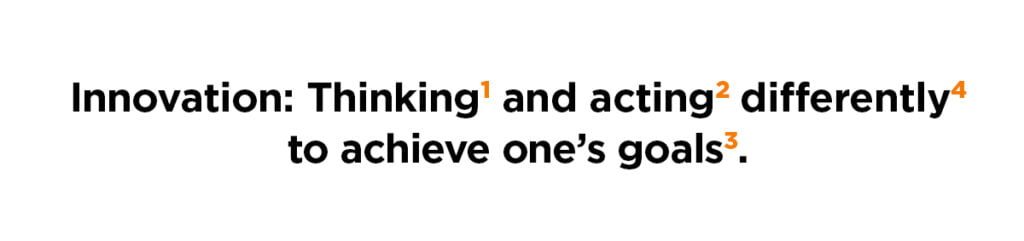
To innovate is to think and act differently to achieve your goals.

Let’s zoom into each of the four key elements of the definition, in turn.

  1. Innovation is first and foremost the fruit of a cognitive, thinking process. It requires conditions, both emotional and material, but the first and often-overlooked condition is supplying people with time to think. “Think”, not as in “how and what do I quickly answer to my boss’s complaint?” or “what 15 things do I need to do today and how the hell will I make time for them all?”, but “think” as in taking time off from one’s incessant race to reflect on it from above or from the side.
  2. Whatever you are doing, you’re not innovating if it doesn’t translate into action. Beware the shiny PPT presentation of elaborate organizational flowcharts describing “our new innovation process”: seek concrete actions leading to implementation.
  3. One of our key rallying cries is: Don’t do innovation – rather, innovate in what you do. Innovation is a means and not an end in itself, and therefore, an action can be considered to be innovation only inasmuch as it supports or accelerates your efforts to achieve one or more of your goals. Innovation leaders, units and consultants often flip this causal relationship and act as if innovating is the goal. This is only natural since it actually is the goal – for them. But an organization needs to remember that actions and initiatives can only count as innovations when they promote the organization’s objectives. This is true also of individuals or teams. Note that there is nothing in this definition that favors “value for the market” or the role of customers or any of the corporate-speak business-oriented language. If your goals pertain to the realm of business, then innovation should lead to business results. If your goal is, say, happiness then, for you, an action is innovative if – in addition to the other three characteristics mentioned in the definition – it increases happiness.
  4. Many actions require thinking and promote the goals of an individual or organization and yet it would not be useful or productive to consider them to be examples of innovation. In fact, most of what members of an organization routinely do falls into this category. Doing your job properly, improving your processes, using Quality tools, all these important and commendable activities can contribute much to an organization, and yet we would still not wish to define them as innovative. The last and crucial ingredient in our definition, therefore, is that your thinking-based and goal-promoting action must stem from thinking differently. This, of course, begs the question of what will be considered as different enough to count. We offer a simple and powerful answer: thinking differently means breaking one or more of your Cognitive Fixednesses.

So, introducing this concept into our definition we get:

You innovate when you think and act in a way that breaks your fixedness leading you to achieve your goals.

This working definition lends itself to numerous practical applications. It can, for example, be immediately translated into a useful pair of criteria when you are asked to approve submissions of ideas or achievements to an internal innovation competition in an organization. Those who submit an entry are asked to demonstrate:

  1. The impact of their project (potential impact if the competition is among ideas; measured impact if, as we prefer, prizes go to implemented projects rather than ideas);
  2. Which fixedness(es) had to be broken in order to come up with and/or implement their idea.

These two criteria, when applied jointly, easily filter out hairbrained schemes without demonstrable results (or the potential thereof) and on the other hand embrace candidates from any type of activity in the organization that supports its strategy and goals, without bestowing preference to R&D or other usual suspects. Our definition is not perfect, of course: definitions are notoriously elusive and slippery, and tend to circularity. One way of assessing a definition’s value is by evaluating to what extent it captures all phenomena one wishes to include under a term and how effectively it excludes those one doesn’t. The definition presented here performs well on both counts, I believe, including a very wide range of activities versus the organization-business-product-technologically biased alternatives. It also helps filter out useful but non-innovative activities and even points to a practical direction for those who wish to nudge their current activities towards a more innovative path.

A crucial element in making this definition operational is obviously a clear and communicable understanding of the concept of FIXEDNESS. In future posts, we will delve deeper into this concept, so central to the very essence of innovation.

5 Key Elements in Planning a DT Initiative

Published date: June 23, 2021 в 5:16 pm

Written by:

Category: Digital Transformation,Innovation,Organizational Innovation,Strategy

We opened this series with two posts dealing with the barriers to implementing Digital Transformation in your organization. “Why start with the negative?”, one may ask. First, it is often most useful to discuss the difficulties involved in a certain endeavor, especially when the general tone of the topic is one of unabashed hype. Second, as with other innovation-related endeavors, a major managerial error in DT is jumping into a buzzy-sounding initiative while disregarding its potential pitfalls and therefore doing so without proper commitment and preparations. One key message of posts 1&2 in this series is, therefore: avoid launching a DT initiative if you are not willing to confront the challenges, that will certainly arise, with determination.

In this post we present 5 Key Elements to consider as you prepare to launch your DT initiative. In future posts we will zoom-in to some of them in more detail.

Key Element 1 – Goals and objectives

Why are you launching this initiative, and what are you trying to achieve by it? It may seem redundant to even mention this obvious rule, given that it is the basic starting point for any activity. But DT efforts, specifically, often tend to be driven by the wrong motivations which can doom them from the outset. This is a short list of some of the common drivers for launching a DT initiative:

1.    Public opinion, boards, Wall Street, stakeholders are demanding it;

2.    Competitors are embracing it, and this threatens to give them an advantage;

3.    Talent flows to organizations that are more digital;

4.    Customers demand it;

5.    Suppliers become digital;

6.    Legacy systems and technologies are becoming obsolete;

7.    FOMO, including both the frivolous and the serious versions.

All and each can be legitimate, but only motivations that are exposed and shared can serve as guides for choosing the right path forward.

Key Element 2 – Where are you now?

It is useful to see the path to Digital Transformation as consisting of three stages:

1)    Digitization – roughly, transforming your paper records into bits and bytes;

2)    Digitalization – implementing the tools and processes that allow access and utilization of the digital information;

3)    Digital Transformation – rethinking and redefining your processes and your modus operandi to make the most of digital possibilities and to adapt to the needs of a digital environment.

Organizations often mistake steps 1 or 2 with DT, whereby they not only miss opportunities for reaping the full rewards of DT, but often suffer damage by digitalizing processes that work better in analog. It is therefore crucial to clearly identify where the organization is at the outset of the initiative. This is less obvious than it may seem, given that business units or departments of the organization can be in different stages of the digital journey, that Stage 2 can superficially feel like a transformation although it isn’t really, and that some stakeholders may very much resist the implications of admitting that Stage 3 is still in front of them.

Key Element 3 – What do you aim to change?

Which area(s) will be transformed?

When you say your organization wants to “be more digital” or to digitally transform itself, you must define what it is that you are attempting to transform:

o Products and offerings   o Business models           o Productivity

o Processes – internal         o Processes – external     o Decision making

o Communications – internal and external                o Other 

Some of these may be difficult to transform without changing adjacent processes, others can be dealt with independently. It is sometimes better to go about the transformation gradually, rather than attempting the change all at once. Both approaches have their pros and cons.

What’s going to be D about it?

Even when a certain part of the business has been selected for digital transformation, for example product offerings, even then there are a variety of aspects that can be tackled and transformed and, in many cases, only some of them will. A full transformation of, say, a specific product or process into digital may, and often will, include changing how you:

o     Sense                      o     Collect                         o     Aggregate/store

o     Analyze                  o     Communicate          o     Visualize

o     Recommend        o     Act


Key Element 4 – Technology

When we work with a company to assist in DT, we find it useful to compile lists of technologies. The lists tend to vary somewhat according to domains and with time. In the list below there are four main families with 16 technologies (fluid number) that are often applied to achieve DT. It is not realistic to expect that any single person will be proficient in, or even just deeply knowledgeable about, all of these, but it is becoming increasingly necessary for every executive to have at least a superficial understanding of what they each mean, enabling them to turn to relevant experts with intelligent questions to assess potential threats and benefits for their area.

1.    Thinking and analyzing

a.      AI – Artificial Intelligence

b.      ML – Machine Learning

c.       Neural Networks/Deep Learning

d.      NLP – Natural Language Processing

2.    Vision and processing

a.      AR – Augmented Reality, VR – Virtual Reality, and MR – Mixed Reality

b.      Computer vision

c.       Image processing

3.    Computing and Communicating

a.      Big Data/Deep Data

b.      Cloud

c.       5G

d.      Quantum computing

e.      Social media

4.    Sensing and making

a.      IoT

b.      Industry V4.0

c.       Robotics

d.      Wearables

Key Element 5 – Behaviors

As is becoming increasingly obvious, even to the more technically inclined, digital transformation depends less on the technologies deployed and more on the people employed in implementing them. The mindset shift required for a digital transformation is elusive and can be understood as the adoption or strengthening of a set of crucial behaviors. The following, non-exhaustive list includes some items that are recommended independently of digital context, while others are more D-specific:

  1. Be flexible, break fixedness;
  2. Focus on data: collect it, store, analyze, explore, etc.;
  3. Beyond listening to the customers: interact with the customer in exploratory mode. Both internally and externally, engage employees in new digitally transformed platforms and engage customers to use them.
  4. FFD – Function Follows Data/Digital: search for data, collect it and analyze it even before you understand its potential uses and benefits. This is necessary to overcome the chicken-egg problem of no budget for collecting data until you can prove benefits of it.
  5. Everything is a pilot: pilot as soon as possible, even partially (MVP style), progress from pilot to pilot, treat any version as a pilot for the next.
  6.  Solutions can come from a variety of sources, both internal and external: develop internally, hire the knowledge, assign to freelance, outsource to vendor, acquire tech, acquire company, partner with academia, JV, and usually a combination of some of the above.
  7. Beware overload of data and technologies – do not assume that their existence will guarantee wise usage or any usage.

Following our two posts on barriers to DT, in this post we have reviewed 5 key elements to consider when setting out on a digital transformation journey. In future installments, according to your questions and comments, we will zoom in and expand some of the elements, sharing examples and tips.

Digital Transformation – the SIT version – part 2

Published date: June 16, 2021 в 5:00 pm

Written by:

Category: Digital Transformation,Innovation,Organizational Innovation,Strategy

In our first post on the difficulties faced by organizations attempting Digital Transformation, we shared a few sentences about each of 4 common barriers:

1. It is truly difficult to trust experts on DT, especially the “experts”.

2. Mixed signals from top management.

3. Security concerns (real and imagined).

4. Ignorance of relevant technologies.


Here are 6 more, completing our not-comprehensive list of 10 Common Barriers to Digital Transformation:

5

Regular resistance to Innovation, probably amplified. In other posts you are welcome to read about some of the multiple types of resistance that people exhibit towards any kind of innovation. They all apply to Digital Transformation, just as they do to any attempt to change processes and habits, in general. But it seems that for many people innovation of the digital ilk can be even more frightening than other variants, maybe due to the fact that many of us feel threatened anyway by what feels like a digital invasion in all walks of life. We are bombarded with digital information, we fight with our children about what seems to be their excessive immersion in the digital sphere, we read of, and sometimes experience the imminent dangers and ethical dilemmas of an increasingly digitalized existence. DT at work therefore seems to be yet another front in a losing battle.

6

Problems related to interfacing with existing IT technologies and organization (real and imagined). Most companies striving for DT do not attempt to jump directly from the Stone Age into digital. Most, or even all, have legacy IT systems and whatever new elements will be introduced will necessarily have to fit in with existing infrastructure, hardware and software. This implies: a) a need to allocate additional budget (good for IT, less attractive for Finance); b) a threat to the professional authority of current internal IT experts; c) bugs and clashes between old and new systems; d) an opportunity for renewing aging systems, which creates a dilemma of how far back to go with replacement, versus adding new technologies on top of existing ones. These dilemmas can paralyze the entire DT initiative.

7

Lack of clear ownership: regular business owner versus IT/tech lead, versus owner of “Digital” if there is one. In one organization you see a digital expert brought in and put in charge of “Innovation” without any knowledge or previous experience in the latter, while in another an innovation expert is assigned the responsibility for a “Digital Transformation” project she has no ability to lead. In both cases the reasons for the decision are an attempt at efficiency (“can’t waste two headcounts on the fluffy stuff”) and a foggy understanding of the differences and interconnections between the two topics (“he’s an expert on digital, that’s what innovation is all about” or “she’s an innovation expert, she can cover the digital transformation part”). IT will also be angling for a position at the DT table (“it’s all about IT, the systems we’re in charge of”), and HR wants their voice to be heard (“it will all depend on the people we hire and on upskilling digital capabilities”). They are all obviously right, often leaving the organization without a clear leader for DT, or worse, with several.

8

Lack of structured data to start building on. Imagine my surprise when the VP IT (and responsible for her organization’s DT initiative) of a leading HMO in the US confided in me that, while they are truly committed to a genuine DT process, she expects the interesting steps to kick-off at best only within a couple of years since they are currently grappling with the uninspiring task of converting their (literally) millions of medical records into digital format. Even technologically oriented companies tend to have a huge installed base of “dumb devices” that were never designed to collect data, or minimally so, or produce unstructured and difficult to use data. This lack of accessible data often makes it difficult to even imagine digital offerings (the “what”) let alone how developers should go about tackling the challenge (the “how”).

9

“Digital” is seen as an add-on, or a translation process to be applied to products and offerings. In 2004 we worked with a large publisher whose management had the foresight and courage to push strongly for “more digital”, quite a while before this had become the ubiquitous trend it is today. But, alas, their strategy was to create a Digital Team that received all the analog materials at the end of their development process to “convert them into digital”. Surprisingly, even today this is still common practice in many companies, where digital is seen as a kind of different language to which specifically trained experts will translate the regular (analog) products, processes, systems, or communications. First, this approach dramatically limits the potential benefits of DT, since you can only translate into digital what you were able to imagine in the analog world, rather than creating and inventing using digital possibilities built into the process. Second, the approach often creates inferior results since many analog-conceived concepts do not translate well into digi-speak.

10

Timelines and pace: development cycles do not fit the rhythm of change in digital technologies, nor the pace of change in customers’ preferences and habits. Most companies have a single well-structured R&D process, if at all. When they engage in the development of digital offerings, or introduce digital elements in their regular development, they often tend to utilize their existing development process, stage gate structure or other process management and control mechanisms. Even organizations that adopt Lean Startup or other agile methods often embed them into their overall approach due to lack of understanding at top management levels that the rules of the game are different in a digital context.

We’ve seen, therefore, that there are (at least) 10 barriers and stumbling blocks to a successful Digital Transformation. Luckily, we have developed a special pixy dust that can be sprinkled on databases and clouds to…. OK, just kidding. But in consequent posts we will share some thoughts and guidelines that are useful when engaging in this challenging task.

Get our innovation model that has worked for 1000+ companies.

    No thanks, not now.

    sitsite
    Privacy Overview

    This website uses cookies so that we can provide you with the best user experience possible. Cookie information is stored in your browser and performs functions such as recognising you when you return to our website and helping our team to understand which sections of the website you find most interesting and useful.